
Raphaël (00:00)
Hi everyone and welcome to the Bright Signal podcast, where we cut through the noise and bring you the latest tech news and interviews. My name is Rafael and I'm joined by our new friend, Charlotte. How are you Charlotte?
Charlotte (00:13)
Hi, I'm good. Thank you.
Raphaël (00:15)
So Charlotte is our new co-host and as you know we interview more and more tech startups and in the future tech investors in a broad sense, so maybe P, V, C or Angels. And in this context we try to differentiate ourselves by bringing different and complementary expertise around the table. So this is why we have Charlotte who will bring the EU policy background. but maybe Charlotte, who are you?
Charlotte (00:45)
Hi, so I'm Charlotte. I work in EU Digital Affairs. So I spend my time following up on like the new legislation of the European Union, like the AI Act or the EU Tech Sovereignty Package or the Cloud and AI Development Act. and I look forward to sit down with founders and companies to discuss how they see the policy angles or the European policy angles in their day-to-day life and in their companies and what effects that they have.
Raphaël (01:10)
And this isn't your first time on the on the podcast as you covered back in the days of the monkey patching podcast with Barton Morillo a whole session about Belgium AI strategy and the EU AI acts. So you were a kind
Charlotte (01:25)
Yeah.
Raphaël (01:26)
of a co-host before I was.
Charlotte (01:27)
yes, maybe. Yeah. It was somewhere in December I think that the podcast came online. So I was part of there. So if you want to know more about me, you can just watch that podcast and you are totally up to date on what I do to on a day-to-day job.
Raphaël (01:41)
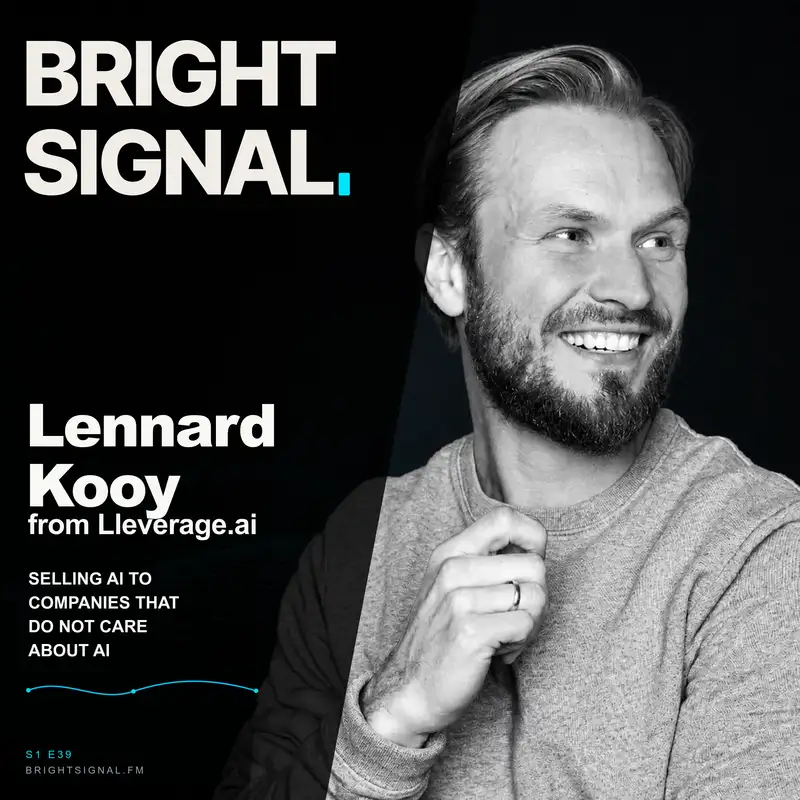
And for the first founder interview with Charlotte, we just sat down and discussed with Lennart Koy from leverage.ai.
Charlotte (01:50)
Yeah, so Leonard is a CEO and co-founder of Leverage AI, and that is an Amsterdam-based startup building AI agents for physical good companies. Leverage is building an autonomous back office, so they try to for operation teams that move and sell physical products. So what they do basically is making sure the back office is running more up to date with reading pushes or the matching invoices. and Leonard himself built and sold already a company called StoryTech before. before this company, before leverage, and within leverage I already raised five million dollars across peace pre-seed and seed rounds. so that was it about leverage. So let's go to the interview.
Raphaël (02:25)
Let's go to the interview. Hi Lennart, nice to have you on. Thank you for joining us. Can you maybe start by introducing yourself and explaining bit your background?
Lennard (02:38)
Of course, thanks for having me. My name is Lenard. I'm the CEO and founder of company called Leverage. And I'll explain a bit what Leverage does, but also a bit of my background. Leverage is a company that helps companies in the physical economy, we always call it, so industrial companies to automate their back office process with AI. So think about processes like handling orders or planning production, those type of things are things we help automate. We're a team of 25 currently. And in terms of my background, I've been in software for all my life. So once in a while or a long, long time ago, I started as a product owner. then about 10 years ago, I started my first serious company, which was called StoryTech, which was also an automation company, but it was for marketing material. So we helped. big consumer brands to automate their content production, specifically video. Back then that was very novel because you didn't have generative AI, so that was a great tool back then. I did that for seven years. sold that company and when I sold that company, I saw this generative AI wave coming up and that company that I had, had over 100 web developers and I saw that none of them could use that technology to really build functionality that I wanted into my product. Back then that came because the technology, generative AI, was very immature, right? So you needed all these things around it to make it actually work. So the initial premise of leverage was, can we build a platform that bridges that gap between what this technology, Genitive AI, could potentially do and what people are actually doing with it. So that was always the premise of leverage and that evolved into helping companies that are even a bit further down the curve in terms of the AI adoption to implement it into their companies.
Raphaël (04:33)
So you mentioned it, you sold Stereotech, you mentioned that it was your first serious company, what were the other ones?
Lennard (04:41)
for a serious tech company. yeah, I've... Like if people that know me, I think I had like 20 companies. I lost count, but they like the first companies I had when I was 17, I started trading cars, classic cars. That was actually the
Raphaël (04:57)
All right.
Lennard (04:58)
first company I had that evolved into a small leasing company. So when I was in college, I had about 35 cars that I leased out to people. So that sort of got me through college. Well, at least to my paying for the beer in my college. And I traded all these cars as well, but I had everything from an underwear brand to let's say another mini agency. I did have a bit of a bigger company was software for construction companies. So I had all these things, but StoryTech was the first bigger company. So when I left, we employed about 400 people. the other ones were all small smallish if you will.
Raphaël (05:42)
Okay, then you became, so when you sold the company, you became the group CEO of the acquiring company. It was from 2022 to 2024. what made you change from, okay, I'm the group CEO, the tech CEO, if I'm not mistaken,
Lennard (05:59)
Yeah, it was a bit of an odd story. So the holding company that sat on top of it had basically two arms. It was an agency, so a mid-size agency. They employed about thousand people. And then they had a tech arm, so they used all their profits to buy technology in the marketing space. And when they acquired my company, StoryTech, they wanted to bundle all those companies, there were about six of them, and make that one tech company and split that
Raphaël (06:30)
Alright.
Lennard (06:30)
from the agency, if you will. And I became the CEO of that tech part, which was its own company. So I had to get all those six companies and make it one company, basically merge it together. and there was a private equity company behind it so they had these teasers that if I would detect separate from the the agency then I'll create more value as separate entities as then as a whole.
Raphaël (06:55)
You mentioned it. You build more than, what did you say, 20, 40 companies? Which is maybe
Lennard (07:02)
No, I don't know, a 20, maybe 20, I don't know.
Raphaël (07:04)
20. What's it to build the first company in the AI area we know it? Because I think that you founded Stereotech, think 10 years ago.
Lennard (07:19)
Yeah, pretty much.
Raphaël (07:20)
Leverage is the first one that you launched in the AI area? What's the difference?
Lennard (07:26)
think the main difference is the amount of people you need to achieve your goals. like in the SaaS era, let's call it like that. Like having a lot of people was sort of this badge of honor, right? So you said, hey, if I employ a lot of people, you must be doing well, right? That was always a bit the premise. Now I think in AI that completely flipped, right? You even have people that are trying to become a unicorn without hiring anyone, right? So the first person, one person unicorn. So, and a lot of that is based on reality. like the amount of work we can do now with far less people. So I always make the comparison. I currently have eight developers. And if you look at the amount of code they produce, now we're not going to go into quality, we can go into that later. But if you look at the amount of code they produce, they produce about as much code as the hundred web developers I had in my previous company. you look at a month by month basis and the amount of code they produce.
Raphaël (08:25)
crazy.
Lennard (08:26)
So that's a 10. difference in terms of what they can actually handle. And I think that the first part in your organization where you really saw that was development, but you see it in all types of parts. We have a team of implementation, we call them Forward Deployed Engineers, which is a very hip. a word nowadays, but it's basically people that implement your product with the client. And if you see the amount of clients they can handle compared to the amount of clients they could handle when we started, that's already tripled, right, in the last two years. So you can see that they are getting more more productive by basically automating themselves away, mostly through AI, because we have AI agents doing all these components, gathering the information from the clients, setting up the agents, workflows, so we have agents building agents and workflows which is quite interesting, or gathering the feedback and implementing that, or answering security questionnaires, or all those type of things we have automations or agents for, that just wasn't possible two, three, four years ago.
Charlotte (09:31)
And do we then see like a cost change of it because you're employing less people but there is token costs though so
Lennard (09:38)
Yeah, I sometimes make like tokens are getting quite expensive and sometimes I make fun of it and I post on LinkedIn that this could be
Raphaël (09:46)
We saw that.
Lennard (09:47)
done cheaper by humans than by AI. And sometimes that's actually true and I'll get to some specifics, but in most cases, like the token cost that you will spend combined with the human effort that maybe is still required to do something is just far less than employing a human to do it. So look at that developer frame that I mentioned, right? So I still pay those developers about the same amount. Maybe they are slightly more expensive because they are the ones that are like the high experience ones. But then I add, I don't know, 500 bucks per month on tokens on top of it because they have two max subscriptions at whatever. but they can produce the same amount of code as let's say seven or eight developers. So that's still vastly outweighs, let's say, hiring humans for it. That being said, is what you see happening now in the market. is that people are using AI for everything and they use the most expensive model for everything. Because we as humans are lazy, right? So you go to, I don't know what you use, OpenAI, Anthropic, and then it's standard on Fable or Opus 5 or whatever, or GPT 5.6, what is it now, Sol. And then you just ask it a very dumb question. Not dumb as in you shouldn't have asked it, but it's something that a far less superior model could have also answered. But you are paying 10 times the amount because you are just too lazy to change the model picker because nobody wants to do that. And then you get into this paradigm that sometimes you are asking you to change a presentation that you probably could have done yourself in 10 minutes but you're lazy or you don't want to do that anymore so you throw everything in this model and it needs to gather all the context etc etc etc and it might be that it costs you 30 bucks to change it for that model. Now, if it's only 10 humans and human, then you get to this point is what is cheaper, the human or the AI here, right? So that is sometimes you get to that point and think that will change in the coming years. But we're currently at this sort of interesting point where sometimes doing it just manually is cheaper than asking the AI to do it.
Raphaël (11:57)
Maybe back on the company, we didn't mention that, you are the CEO of Leverage. building the autonomous back office for operations team at company that make, move and sell physical products. And I'm not inventing something, this is written on the web and also on your website. This is for a wholesaler, manufacturer's, logistics company. Can you maybe elaborate or explain with your own words what you are doing in plain terms?
Lennard (12:29)
Yeah, like I said in the intro, what we do is we help, for example, manufacturing company to automate part of their supply chain or back office through AI, but often it's automation with a bit of AI in it. But if I say it like that, sounds like an agency as well, right? They have a lot of agencies that help people to automate a certain process. And what we're building towards is, how can I take a manufacturer of, I don't know, 500 employees? Where often they excel in producing the product that they're producing, but they're often still quite, let's say in the stone age when it comes to their desk workers, right? So what you often see is they have this lovely plant and they have all these robes doing all types of things, doing really sophisticated processes. But then when you walk upstairs, have people still printing out Excel to do the planning or going through an email and sifting through an invoice to understand what's in there and matching it with their ERP and doing all that stuff manually. So what we do is we help to get that manufacturing company and achieve the same level of innovation and automation that they have on their factory floor in their back office as well. So that's what we do. And when you translate that to very practical things often we see the same type of processes at for example manufacturing. So it is a lot with, hey I need to produce quotes for clients. I get orders and I need to handle those orders so I need to see can I fulfill this order? Do I have it in stock? Do I have it at the price that they asked for? Those type of things. you need to do stock management, hey what kind of things do I need to have on my factory floor to actually produce this order. You need to plan your production to make sure that you actually get it out on time and then you at some point need to send an invoice and you receive a payment and you need to reconcile the payment with the invoice. So all these type of processes, those are things that we get into and we often start with one process and then from there we work our way through the entire back office and that's why we say hey we help companies get to an autonomous back office because that's sort of the vision that we go on together with this client. How do we work from all the manual work you're currently doing to something that works by itself.
Charlotte (14:52)
And do you see a you say that it's the same problem that comes back every single time, but it's a bit different every time, right? So
Lennard (14:59)
So.
Charlotte (14:59)
it's more on the premise or you sell more?
Lennard (15:03)
Every company is unique, right? So I always say they, lot of companies have similar processes, but they're not the same. none, we don't have a SaaS as you would think about the SaaS. So every client implementation is specific. So our product is this box of Lego and that's also how it looks on the front end. it is all these pieces you can puzzle together to facilitate automating one particular process. And obviously we've seen certain processes a lot of time. So, and we take the knowledge from every process that we implement, the generic part, right? Not the specific business rules or things that are owned by clients, but the generic learnings. And we put that in our own and our own, we call it company brain that we can get into later. And then when we go on to a new client, we take all that knowledge and then allow it to get better every time. So basically it's a configuration specific to the client every time, but you see a lot of patterns that are very similar across clients.
Charlotte (16:07)
So there's a consultancy angle also to the business, basically. Okay.
Lennard (16:10)
Yes, it's something we also automate, right? So it is, I always say we are software plus services to an extent. So what people typically buy, especially when you're a wholesale manufacturer, you buy a piece of software, which is an ERP or a warehouse management system, something like that. And then you get an implementation party that also makes sure that it works with you. Or you have to do it internally yourself, but then you have to put in a lot of work. And what we typically say is, we do both in one package. So we deliver you the software that we build ourselves, but we also implement it for you. So those are those four deployed engineers I talked about. They implement our own product, or we have partners that implement it. But we go about it in slightly different way than an agency. Because an agency, bill per hour. So they get paid the more hours they work. Which is always a bit frictionless with the client that they work for. And what we try to do is, hey, how do we take these people that implement our products and how do we make them... sort of automate themselves. So we are constantly thinking about how do we instill the knowledge that we gather into our product so that our FTEs don't have to do that again. Which is a very different mindset because we charge per agent. So instead of, hey, here's a piece of software, now you're going to pay me hours. We say, we're going to do this production planning agent for you and you pay, I don't know, 20K per year. So we try to compare it to an employee rather than a piece of But we package everything in that fee so the implementation time is basically our risk, right? If we spend a lot more time that will cost us more money. So it's a very different model than, I'm going to pay you hours to implement this.
Raphaël (17:56)
It's kind of an all-in-fee, basically.
Lennard (17:59)
Correct, yeah, yeah, yeah.
Raphaël (18:01)
shifted a bit your focus because you began back in 2024 as a low-code platform for all kinds of clients, all sectors. Then you shift a bit a few months ago, if I'm not mistaken, to focus a year ago, all right,
Lennard (18:18)
About a year ago already. Yeah.
Raphaël (18:20)
for, as you mentioned, agent for the wholesale and logistics sector, what's happened in between? Was it because you had a lot of this type of client in this sector? Or the inverse?
Lennard (18:36)
Partially, Yeah, it was a bit of natural evolution, I would say. when we start, so the premise was always, hey, can we build something that allows companies to implement AI? And we started with a, why don't we build this for everyone? But for everyone, back then meant mostly for technical people because no one else could use it at that point. But then what we saw in the market was that all these big model providers that they were catering towards technical people, right? Because they were their early adopters as well. I'm talking about OpenAI and Entropic and all those types of companies. So for us, that sort of meant, okay, that is something that that market is going to be claimed by all these big providers. And then we got a couple of clients that said, it's great that you that you built this platform, but I still need a technical person to implement it. I don't have any of those. Can you implement it for me? So being a startup, you said, okay, why? Sure. I'll do that as well. Right. Because you need to sort of test the waters. And those were actually the clients that got most value from us. because we actually helped them to implement it and made sure it worked and then they actually got to value a lot quicker than if people tried to do it themselves. And at that point, we saw these two things. like all these big players are going to basically capture the market that we were initially targeting, which is developers and technical people. And on the other end, the clients that we have that are most happy are the ones that we actually helped implement. Maybe there's something there, right? Why don't we do this software plus implementation play and then focus on companies that can't do that implementation themselves because they simply don't have the experience for it. And that sort put us on that path. And then in the last year, we've been progressively going more and more into what I call traditional companies, because we see that we can deliver more value there. So if you take a manufacturing company that has an on-premise ERP, they call it, right? So everyone is on the cloud and they have like APIs and all that sort of technical things. But let's say you haven't upgraded your ERP in the last 10 years. So you're still running it on the server that your IT guy set up, I don't know, seven years ago. And the only way to get there is through this very obscure way of putting something next to that server and then talking to it. That is something we actually enjoy. So hey, that's a really nice problem to solve, right? And it's also something AI can't solve for you because you really need to physically go there and solve that, et cetera. So that's something we actually enjoy doing. And also... gives what you do, what we do, a lot more value than what you can just do yourself with AI. So that is sort of the value we can create with these traditional companies, just far greater than the value you can create with a tech company.
Raphaël (21:23)
And there is a sentence which was written in one of your last job offerings at Leverage that I found really funny but also true that illustrates a bit what you are saying. So you shared a commercial position and introduced it. So it was the first sentence. The most interesting commercial job in AI right now is selling to companies that don't care about AI.
Lennard (21:48)
Yeah, and that's, yeah,
Raphaël (21:49)
This is-
Lennard (21:50)
we mean that to it. nowadays, I don't know how your LinkedIn feed looks like, but mine is obviously very skewed to everyone talking about AI, right? So everyone is talking about AI and everyone wants to use AI. And then you go to this manufacturing or let's say this, I don't know, a company that does, produces cheese. They don't care about AI. They care about producing cheese. which is this very interesting mindset. You can do this with AI and say, I don't care, I just want to make the best mozzarella in the world. And then on the other hand, they do see that they need to get along with the program to an extent if they want to also be able to produce mozzarella in 10 years time still. So they want to, but they also don't want to, at least they don't care about AI on itself as this innovation. They just care about, how can this help me potentially? Which is a far more interesting sale to make than, yeah, you want someone by AI, I have AI, here's AI, right? That is a very simple sales, almost no intellect required to do that sale. While the ones that don't care about it, but some where know that it can help them, that's very interesting, interesting dynamic.
Raphaël (23:05)
It's also a kind of verticalization also on what you are doing. And we can see that in the market right now with AI, I think that more and more horizontal AI companies that were building solutions for all the markets are shifting more and more into verticalization because as you mentioned, big players are a bit disrupting the market and creating solutions that just replace what people were building. And also, know, I work in finance and a lot of private equity funds are bit stressing out because they have a lot of underlayings or companies that are horizontal. And one argument that they mention each time investors are asking questions about how stressed is the tech underlayings in their portfolio is that, don't worry guys. all of our companies are now verticalized and this is their main argument.
Lennard (23:59)
Yeah, yeah, which you know not to be true to a large extent, right? So that is always the... I don't... I'm a bit... People call this the Sassu... apocalypse, right, of the SaaS apocalypse. So if you're a PE investor in, for example, SaaS, like a software, but also in agencies, if you don't have a very specialized thing that sets you apart, you are at risk of being disrupted. I think part of that is true for a certain amount of companies, but there are multiple ways to differentiate yourself, right? It can be, I have this specialization in a particular vertical, Or I have this specialization in a particular thing, right? That can still be horizontal, but you can be very good at something that is very horizontal, but quite specific. But there's also just what I call distribution mode, they call these things, right? So what keeps you in a mode of a castle, right? So what defends you from the antropics of this world storming your company? If you look, for example, at a Salesforce. Now, They don't have a product that is impossible to replicate nowadays. Like 10 years ago, forget about it, right? So complicated, so many development hours. Now you could probably replicate it and build a CRM in, I don't know, a couple of months with a group of people that is similar to Salesforce. what they do have is distribution. they have, I don't know, 20 billion in AR. They have clients that trust them where they've had this contractual relationship for a long time. They have a brand name that everyone recognizes. And so they have this distribution mode, right? So yeah, why would you... take the risk of doing an AI version if you've been happy with this company for a long time and they're trustworthy and it never fails. this is especially true what we call for systems of record. So I think that part of this private equity story holds up, right? If you have one of these key ingredients, you either have this distribution mode that you have, or you have this very specific knowledge that is in public domain. So AI can't replicate it, whether that is vertical. or whether that is something that is very specific but holds up in horizontal as well. I think then that story holds up of private equity. But what they often do is saying, yeah, all these things are true, right? What I just mentioned. So my portfolio is not at risk. What you often see is that still half of that portfolio is at risk because they don't have any of those three things, but they just
Raphaël (26:32)
Hmm.
Lennard (26:32)
say, hey, my entire portfolio is not at risk. And the reality is also just if you look at a lot of these markets, capitalizations of publicly traded companies that are, for example, traditional software, they are under pressure, right? to large extent, like sometimes they go up a bit, but in general they are half of what they used to be in 2022. So there is pressure to an extent.
Charlotte (26:57)
the market you're in is quite industrial, and quite as is it also as ME based or are you more looking at like the bigger companies within it?
Lennard (27:05)
It's always a bit, what do you see as an SME, right? I think that
Charlotte (27:08)
Yeah.
Lennard (27:09)
is different for everyone. But what I call our ideal company, our ideal customer, is somewhere between 200 and 2000 employees. So I would still classify that as SME, right?
Charlotte (27:21)
Yeah.
Lennard (27:21)
And then the ones like of a thousand or two thousand employees, they're more like mid-market, I would say. We go a bit smaller sometimes and we also go a bit bigger sometimes, right? So we also have a contractual relationship with Lufthansa, for example, or Bosch. So they are far bigger companies. But I would say our ideal is around that, let's say, I don't know, six, seven hundred employee mark. So they're often big enough that they have processes that you can really help. but they're not an enterprise and there's a reason for that because these enterprises are often already helped by Accenture or whatever. So we can add more value at that mid-range or large small companies if you will.
Charlotte (28:02)
That's like one of the things the European Union is now really working on. They're trying to activate SMEs policies to get more into the AI data phase, like the apply AI policies and stuff like that. Do you see that like reflected in your work now? That they are more active in using this? And then the follow-up question also on that is what are like the strangest objections you see within that SME field or like with your and your customer base on using the AI scope? Because that's very interesting for us to hear. Okay.
Lennard (28:34)
So on your first question, they're getting more into it, but there's still this, if you take a comparable company as us in the US. You see that those companies are just, I would say, 12 to eight months ahead in the curve in terms of adoption and being open to this innovation. You've seen that with basically all big technology waves in the last 20, 30 years, right? With the internet, with cloud, and now with AI, you see that Europe has a tendency to lag in its adoption, which is, think, partially a shame, partially a positive thing. And you can argue both ways. And you can ask me a bunch of questions on that later. But so, that's only your first question, but it is... Ticking up right so you see where two years ago only there are real daredevils and innovators wanted to try it now a lot of companies understand Hey, this is this new thing that everyone is implementing. It's probably wise to at least start experimenting with it and and seeing what it can do for my company So there are is there more willingness than there was for example a year ago, and it is picking up That being said, there are still quite a lot of objections. Some valid, some less valid. And I think one of the things is that people classify us as an AI company. So when we come to a company, they always put this in the AI bucket. Now, funnily enough, like when we implement a solution, I would say often automation, maybe 20 % of that is often AI. sometimes 50%, sometimes none, but they still see it as an AI solution. Because we are an AI company and maybe for one tiny piece there's an LLM involved. So it's sometimes hard to explain to people, hey, what is AI? What isn't AI? How should you view this? But once you've gone through that, are still a couple of things that people typically sit with. Like one of them is they still perceive AI as this thing that can hallucinate. When you started using GPT 3.5 or 4 or whatever, like half of the questions is all answered were just incorrect. And people have that notion imprinted in them that AI can be wrong or it can be so it can't do any of my critical processes. While in reality, like a lot of the things we do, you can get it to 100 % reliance. But people still live in this paradigm saying, hey, this can still, I don't know, dream up things, which often isn't that relevant for the solution that they have. they often also sit with security, right? So, hey, I now have my infrastructure, et cetera, et cetera. And now I'm introducing this AI, and that might be fueled by a large language provider that sits in the US, and might be called OpenAI or Google or Entropiq. I understand that as well, but if you really drill down on that and I asked this 700 people manufacturing company, I asked the IT provider, say, okay, I get that. But where do you run your infrastructure? And they typically say Azure. So, okay, you know, that's owned by Microsoft. So what is your, why do you prefer Microsoft over Entropic? Is there a particular reason for it? And then they fail to understand that these are the same kind of adversaries, if you want to call them. So why would you entrust all your data that you have and your productivities with this one American company, but you don't trust the other one? Is there like a real reason for it? Might be if some people say, I don't trust them open up OpenAI. Say, okay, maybe that's a fair point. But purely on the instinct, yeah, this is AI and they have the same legal frameworks, right? They have the same stipulations in their contract. what they do with their data if you really read through them. So often that's a bit of a non-argument. But it is something that people sit with. Now you can argue that maybe the answer should be, I don't want any of my data at any American provider. But then you have to make significant different decisions throughout your company. And then you shouldn't pick just, hey, for AI, I'm going to disallow any American provider. But for the 99 % of the other processes, I do trust them, right? That doesn't make that much sense in my opinion. Now, the most important argument we get. is actually humans. And I think this is the most valid argument I get. So let's say we come in at a company and we help them automate their order stream. A concern I often get is what will this mean for the humans? How will this affect their jobs? What will they think of it if we now start introducing this AI that partially helps or automates their job? How do we handle that? What do I do with these people? How can I upscale them to do something else? Now, I think these are far more valid concerns than the one I just mentioned. And the honest answer there sometimes is, yeah, it really depends on what kind of what you want, what you can do also with these people. Can you bring them? to different parts of your organization or does this mean that you have to, yeah, maybe let them go and then maybe don't introduce AI, right? If that depends also a bit on what kind of employer you are. So.
Raphaël (33:51)
Did you see that? Did you see like when implementing something that the outcome was firing people or just letting people...
Lennard (33:57)
Yes, I did. And sometimes we struggle with that internally as well, right? So the thing that you're doing is costing people their job. And that is especially true for bigger organizations that, yeah, they just need to reduce costs, right? And this is a way to reduce costs. You see that a bit less with, I don't know, more like our ideal customer, which is like four or 500 employees. They often have a very big loyalty towards their employees if you go more in these traditional industries. But we do see it with enterprises. Yeah, that sometimes is a struggle, but in all honesty, we try to help and kind of tell them how other companies are doing these type of things. But in reality, it's not really our job and place because if we won't do it, they will do it with someone else. So that's a bit of a...
Raphaël (34:49)
Yeah. And that's the market. Also on the market, you are having traction. raised, so you had two fundraising. So you raised a total of five million in two rounds. Two million pre-seed in 2024 from angel investors and then a three million seed phase in 2025. It was led by PIC, a VC Amsterdam based fund. that I didn't know. I think, depending on your angel investor, it's really like Dutch capital, Would you look for more pan-European capital or even US funds in the future for a potential Series A?
Lennard (35:32)
Yeah, I would I would highly prefer European. not even because I don't I dislike Americans, not the case, but like our premises often, hey, we are this AI company from Europe that is will guide you through all these innovations in a decent and secure and reliable, reliable way. And you sort of counter that if you then take US investing at least from a Yeah, like how people perceive it, right? So the perception might be, although that might be perfectly like a great investor, et cetera. The reality is also on the other hand is that US investors are just way, they have way more capital. Right, so there is always this tipping point that if I can raise double from a US investor that you start thinking about, what would be best for my company? But the preference is to do it from a European fund. And our goal is also to expand to more European countries. So it makes sense to do that with a non-NL venture capital firm, actually, but I would prefer a German or French or UK fund
Charlotte (36:38)
We see the U EU preference angle coming back in quite a lot of companies now and also the U is trying to the for the government are trying to gain that angle. do you see that difference? That there's like more trust in European companies than US or Asian companies? Do you do can you play out that angle in your marketing or in your sales pitch?
Lennard (36:57)
Yes, but it's not never the It's it's more like a ingredient, right? It's hardly the only it's almost never the only ingredient But if they can choose between a US company and a European company that offer the same price and the same product, they will go for the European company. And it might actually be that we can be 10 % more expensive, for example. What they don't do is say, hey, you're 10 times more expensive, but I'm still going to go for you because you're European. So there's a bit of a balance. But you do see companies preferring that. I think it's also a bit fueled by the day and age we live in, right? Because you couldn't have imagined this five years ago, right? Because the US was this reliable ally and we all seen it as the same thing. And yes, of course you took Microsoft because like, right? And the last two years, I think due to political, yeah, let's say macro political forces, people are... Yeah, changing that perception and what fuels it is if you like this very distinct things that happen like you have this Entropic had this model they called METOS, which I always say is more like a marketing stunt than something real, but sure it was a really good model and then then the US government saying, yeah, nobody can use this except us and a couple of US companies. And that is so public that everyone thinks then, okay. But that's They are kind of weaponizing this AI thing. And that breeds a lot of distrust from Europeans. So, hey, you're going to keep the pearls for yourself and I have to make do with whatever is left. And that of cycles back into the minds of European company owners that then think, okay, but these Americans, can't really trust, right? Not with everything I have. I want to do business with someone that I feel I can trust, which is then often the European alternative. So you see this sort of shift and it actually is tilting towards some companies I know that start to prefer the Chinese models or Chinese infrastructure over your American ones. And always people are always these, but those are Chinese and they are like spying, et cetera. I'm also a bit more, you why would you trust everything in the U.S. but distrust everything from the Chinese? Like this is changing, like the world is changing in that regard. And I think you see that reflected in a lot of people are figuring out where, what to trust and what not to trust.
Charlotte (39:27)
In twenty twenty four I think you've written an article where you talked about Europe being at risk of becoming an open air museum. over the last two years, so now we're one and a half years later than that article. Do you see a positive evolution or are you still on that page? Like frontier or eye models, we don't have that piece of the puzzle, but for instance in quantum and stuff there could be a potential for European excellence, so to say. Do you also see that option or
Lennard (39:53)
I see the option, quantum is not something that is widely used yet.
Charlotte (39:56)
Yeah.
Lennard (39:57)
If you look at a lot of the, not only in AI, but so this is more like a political WACO, if you see a lot of the elements that make a superpower, Europe isn't owning any of those. Right? So whether that's AI or whether that's, let's say, a defense industry that you can use to really deter your enemies or whether it is even the industries that we did excel in, like automotive, is now something that isn't our game anymore. Right? It is something that is now belongs to Asia mostly, if you're realistic. And you have a lot of these, these things happening that aren't necessarily for the better for us. Now, I always explain it to like, probably still live in the region that is most happy and I honestly believe that right so I prefer vastly to live here than to live in the US or to live in I don't know Shanghai but that is something that is in my opinion will become under distress if you keep this base or if you keep this situation for too long because If someone else is dictating whatever is happening, both on the technical front or technological front or on political front, you have a big risk of being in a place where you're not second but third and everything is decided for you. And I think you already see that happening with a lot of things. we're just not at that place anymore. They don't take us serious enough to be able to enforce that will. well, 40 years ago, they would have listened. So our values that we project on the world are at risk of being, yeah, I would say compressed or challenged or and I think that's a big risk. Are we getting out of that? I don't see it yet, in all honesty. And I think a lot of, if you really look macro, you think about back in 40 years ago, it's also one article I at some point wrote, the average salary of a European, European, different Europe than now, but let's say the constellation of that European Union, the average salary of that person from the US was pretty much the same. look ahead 40 years and the average salary of a US person is almost twice of a European person. And that is reflected somehow. Not always in happiness, but at least in influence. And you can argue or you can question whether that's a good thing.
Charlotte (42:24)
And do you see some actions that could be made from Europe or government perspective to change that? Or is it radical change more free market aspects or what's your opinion on that angle?
Lennard (42:35)
I think what I've seen with politician making that the willingness is there. A lot of people are seeing, starting to see this, right? I think that's also changing in last two years. But the way we've set up Europe, it's very hard to make these radical for better or for worse, because sometimes it's also for better, because we have this very democratic system that... includes and I also think that safeguards a lot of our values, but it also makes it very hard to make these, yeah, very hard changes of course, what you see in the US and in China, they basically have a dictatorship, if you're very honest, to a large extent, right? So they have this one person that charged the course. And therefore they can make these very snappy decisions. And I think we live in a day and age, that the system we have in Europe might be a bit too slow to adapt to reality sometimes. I don't know what you can do about that. And I'm not a big fan of a dictatorship, don't get me wrong, right? So I think there's this friction between how do you set up a governing body that can react to a very...
Raphaël (43:41)
Maybe subsidize? Subsidize could be an option.
Lennard (43:46)
I think there's multiple things here. Yeah, we could go in there, but I think as Europe, you can go into this direction. How do we create a... a situation that we can adapt quicker, that we can make these decisions quicker. And I think that's something for the policymakers in Europe to figure out. And I think a lot of the policymakers actually want to, but it's just the length or the time it takes to affect these changes is just too long.
Charlotte (44:15)
Yeah. I I think you're right there with like the reaction is there. So we have currently couple of proposals, for instance, like the EU preference to be written to law that there like that with like with procedures like government contracts that there's like an EU preference clause in that. but the reality is in order from the publication from the commission in order to be voted and actually become law, there's two years and then it's then it's a smooth procedure. So there is a reality based into that that it's A bit lagging behind, but then we also have democracy and we don't
Lennard (44:48)
And that's great, right? But then on the other end, Xi says, yeah, Chinese preference, and they've always done this, but like I call it just protectionism, which I don't think is a bad thing, and I'll explain why. He just yells that, and the next day that's maybe not written into law, but it is already happening, right? So that is what it is. And like... People think, yeah, but the EU preference isn't like a democratic, but the reality is that if you're very honest, like we are the third economic power in the world, right? We're not the first, we're not the second, we're the third. If the first and the second are being protectionists, what they are, like Trump, they are very, they subsidize, the Chinese
Raphaël (45:27)
Mm-hmm.
Lennard (45:28)
subsidize the car industry. Like the Trump administration is, if Intel has a bit of a dip, they just pour 10 billion in it to make sure that it comes out of this dip. So they do all these things to basically make sure that they are subsidizing or protecting. Like ASML, you can't even ship. you can sell to China etc. Then if you're not as Europe you are playing a losing game right because everyone is cheating and you're saying no I'll... adhere to the rules. But that's not, that's not a, I don't think that's a lasting, lasting strategy. So I'm a, I'm a big fan of doing that. But like you, like you said, we should probably just have the ability to say, hey, we all feel this is good idea. And the majority of the EU Parliament voted in favor. Now, can we get this into law in four weeks instead of two years?
Raphaël (46:19)
And in all this policy discussion, if we are coming back to leverage, how do you see the next or two years ahead you what could be a win for leverage specifically.
Lennard (46:34)
Well. Like something like this obviously is a win for us. In honesty, like the only real competitors that we have, sure there are some other European companies, but what we do specifically, almost all our competitors are US based. Being that Microsoft themselves or smaller companies that let's say do what we do but are better funded from the US. So like having something like an EU preference clause, even if it is sort of this cultural mindset or that you get people in saying, hey, actually should prefer to buy European will help to some extent. think it's also like people are getting less afraid of AI. I think from an EU perspective and from a policy perspective, there's a large role to play to frame it in a way, say, hey, this is a great new technology and you should probably try to get the best out of it. But there are some rules, right? And I think that combination. you do that well, that gives people a lot more peace of mind than saying it's great, you can do everything with it. So the combination of, this great, but there are some rules, gives people this framework to work within. And we are doing that with the AI act, et cetera, but it's getting that publicly available and getting people to understand what it means, et cetera, doing a bit of a better job in that regard, I think will help. From a policy perspective, is, hey, make sure there are rules, but make sure they are pragmatic, they are realistic, and they frame the technology in such a way that it will actually benefit us. Because I prefer to have sort of a framework to work in than not having it, right? And then on the other hand, if we can, if there is a bit of a buy EU first, I think that's, yeah, it can only be positive for us.
Raphaël (48:21)
At the end of our podcast, we like to have the same question for everyone. This is bright signal question. Which what's the one signal that you are sending to the market that everyone else is missing? If you were to answer this one.
Lennard (48:39)
So, I actually have, like we're an AI company, so everyone talks about AI, but I have this very strange preference for human content and human interaction. So I think if you talk to a lot of AI companies, they talk about like how... great AI is and the idea. And I think what we often try to tell the story of is yes, AI is great, but it is really great if it can. keep humans being humans and AI just being the stuff that didn't make you human anyway. And what I tried to explain, we would say, hey, if you are filing an invoice in an ERP, nobody really likes doing that. Right? So there's just like, if you have AI doing that, but you do like, hey, maybe there's this interaction with the supplier that I can have. How do I make sure that you pay the invoice next time a bit better? Because that is something like that's more human. So we like to, I like to frame it as yes, AI is great, but humans are actually far greater and far better and try to position it as such also in your company and let's say as a whole you can use AI for a lot of things and it's great but don't use it to have interaction with your friends or with your your wife or anything because that's something you should do yourself.
Raphaël (49:56)
That's nice words to conclude the podcast. Did you read book, like the Pope's book about AI? Alright, alright.
Lennard (50:03)
Yeah, well, part of it. Yeah. I think he some of the same, same notions in it. Yeah.
Raphaël (50:09)
That's why I mentioned it. Anyway,
Lennard (50:11)
Yeah.
Raphaël (50:12)
thank you very much, Lennart. Maybe if people are interested to know about you and Leverage, how can they stay up to date and maybe reach out to you?
Lennard (50:22)
Obviously we have a website which is leverage.ai with double L in the front. it's
Raphaël (50:27)
We'll put it in the description.
Lennard (50:29)
L leverage.ai and you can reach out to me on LinkedIn if you want to send me a message or follow me there. Sometimes I post some content of the things that I also just mentioned. So I think those are the best ways to keep in touch.
Raphaël (50:45)
Alright, thank you Lennart.
Lennard (50:46)
Likewise, thanks for having me.