Raphaël Di Giambattista (00:00)
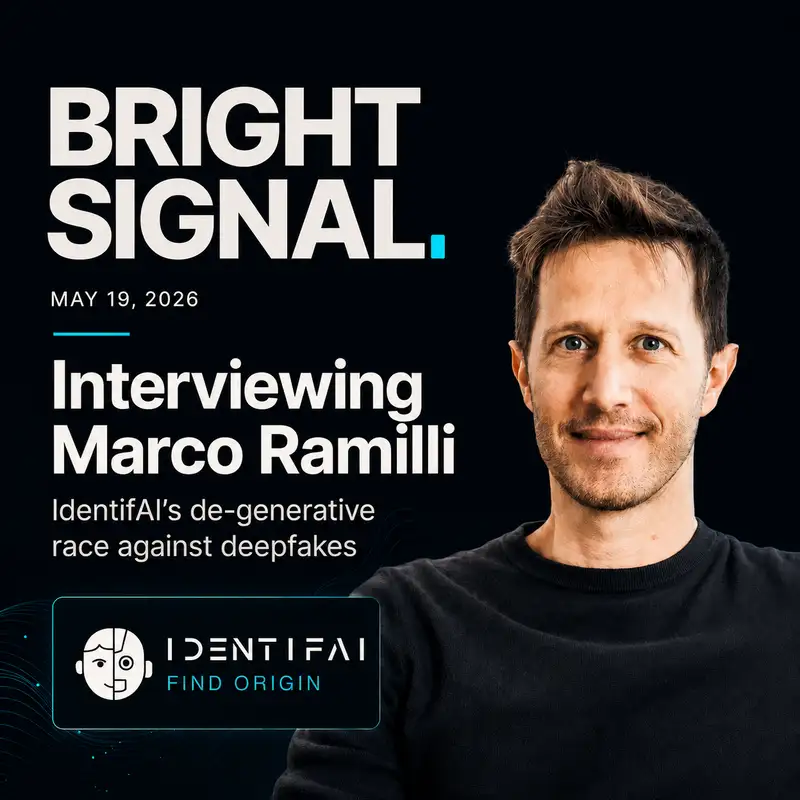
Hi everyone and welcome to the Brightinal podcast, where we cut through the noise and bring you latest tech news and interviews. My name is Raphael and I'm joined by my friend Bart. Bart, we just had an interesting discussion with Marco Ramilli from Identify.
Bart (00:15)
Indeed very interesting. Marco is the co-founder and CEO of Identify. Identify is basically on a path to bring deepfake detection to the next level. It's quite a fast-growing Italian startup. They were founded only in 2024, but they did two significant fundraising rounds. A 2.2 million pre-seed and a 5 million series A. And at its foundation is a very strong, complementary founding team.
Raphaël Di Giambattista (00:43)
So let's get to the interview.
Bart (00:45)
get to the interview.
Bart (00:47)
hi Marco, thanks for joining us on the Bright Signal podcast. I'm very happy to have you here as one of the founders of Identify. Maybe you could start by introducing yourself.
Marco Ramilli (00:59)
All right, thanks. Thank you guys for having me. So yeah, my name is Marco. I have a PhD on computer security. I studied in between the University of Bologna, which is in Italy, and the UC Davis, California, where I've been working in malware, reverse engineering, and penetration testing at that time.
After a while, I decided to move to California and to work there in a university. And suddenly, they just discovered me and I was able to join NIST, the National Institute of Standard Technology, which happens to be on the other side of the coast, of course, in East Coast, where I've been working for a while.
And, you know, so my background is ⁓ on cybersecurity and my current job is to, you know, manage them to be the founder actually of Identify where we use the reverse engineering techniques. Let me put them this way to understand how generators are working. So, you know, AI generator works.
and in order to synthesize, in order to build what we call the degenerative AI, which means models, AI models that are able to understand if something is real or not. So what we do basically is to reuse our background in cybersecurity, malware analysis or the pipeline. It's a race, cat and mouse race, where we need to be very quick.
in understanding how new generators are working and how to catch them in order to synthesize what we say the cure or if you want the degenerative model.
Bart (02:47)
Yeah, so the generative model basically tries to identify whether or not something is real or generated by a model, right?
Marco Ramilli (02:55)
Definitely, yeah. So at the very beginning, know, of generative AI, we are talking about 2022, 2023. It was quite obvious by human eyes, you know, that an image, for instance, was not real. I mean, it was funny to see, you know, AI-generated images, but, you know, we were not scared about them. I mean, we were just, you know...
fun about those images. Today is totally different. So today when we see an image there's no chance for human eyes or for human ears to understand if a voice for instance is real or not. And so we said hey if our eyes are not able to understand if an image or a video is real or not probably another AI engine.
Bart (03:25)
Yeah.
Marco Ramilli (03:52)
another AI model is going to be able to understand if it is real or not. So we just explored this path and we figured out that with a certain probability we can identify that.
Bart (04:05)
No, we actually had ⁓ here in Belgium a very interesting test a few weeks ago by a big broadcast network where they had like 10 quote unquote deep fakes, like different types of formats, images, videos, vocals. And there were almost half a million Belgians that did the test. And only I think it's
1.8 percent I think it's that had all the 10 ⁓ all the 10 classifications correct. It's very low very low yeah yeah yeah this was very interesting yeah and you saw like even though some of the images were like they were they looked like real images but they were a bit much too much fantastical like
Marco Ramilli (04:34)
Wow, I didn't know that. Yeah, that's super interesting. Yeah, super interesting. Yeah
Bart (04:48)
someone famous in a cycling course, that's not a pro cyclist, mean, that's clear that it's not, but looked like a real image. But there were also things that were very difficult, like famous singers' vocals, basically a deep fake of that, a lot of people missed that one. So it's a very, very, very current challenge, right?
Raphaël Di Giambattista (05:07)
it became difficult to distinguish between what's and fake. And that's why maybe Marco you created the identify.
Marco Ramilli (05:15)
Yeah, that is the main reason exactly. you know, today is even more difficult since, as you said before, there are many different ways that you can change the reality. So AI-generated images are just the very beginning.
There are many different use cases and many different techniques that you can use to tamper an image. at the very beginning, it was ⁓ quite easy because you just needed to write on your own language whatever you want to see. But today, you can take a real picture and modify a real picture with the words. Or you can just take a real video.
Bart (05:45)
Yeah.
Marco Ramilli (06:03)
and change the voice or just some words that the actor is saying. And often it's enough few words to change the entire meaning of the discussion. So today's ⁓ even more difficult than was before. But again, we know that and we are...
accustomed to follow and to embrace new challenging situations. And so we do our best to contribute to the deep fake detection arena. So that is...
Raphaël Di Giambattista (06:40)
fast evolving company in a fast evolving environment. And in other interviews you were asked why did you start this company. You often refer to the taxi story when you were in the car and receive a picture of the Pope wearing a fancy jacket, which was a deep fake of course, and ask yourself what can I do about this issue? Can I do something about it?
Marco Ramilli (06:43)
Yeah.
Yeah.
Raphaël Di Giambattista (07:08)
So you had this gut reaction. So you mentioned it's pretty recent on 2022, 2023, the emergence of deepfakes. going from this is an issue for society to I'm going to build something to solve this issue, there is a huge leap, a huge gap between these. What was the commercial moments that made you commit to build a solution around it?
Marco Ramilli (07:28)
Yeah.
Yeah, that's a nice question. know, there was not really a commercial point or a commercial moment. On my personal point of view, was the polarization of the people. So, know, that image of the Pope with the fancy jacket, there were a lot of people on X that were yelling or,
saying very bad things against the pope even if there were nothing to yell at or to be hungry about because there were not this image. But even if the Vatican City said, hey guys, this is not true, so why are losing time to arguing or to yelling or to...
to talking about something that never happened, why you are losing your time. And people didn't care about that and they just following on their idea. So that was the moment where this was the point that moved me to say, let's try to do something to contribute. ⁓ I I'm sure 100 % that we will not be the solution because I don't think there should be a solution.
but we won't be a contributor. So we want to contribute to reduce this threat. Because again, if you get polarized, so if you start to say something and even if what you are saying is not true, and you don't have the feeling, the courage to say, okay, I'm wrong.
Bart (09:01)
Hmm.
you
Marco Ramilli (09:18)
but
you're continuing on your path, it means that something is going to happen. I mean, it's something that could hurt the society. And so the idea was to build up a company that is able to suggest to people if what they are seeing is real or not in a way that they can just stop before starting.
yelling or complaining or fighting to something that does not exist.
Raphaël Di Giambattista (09:49)
At the base of the company, two co-founders, Marco Yu, PhD, successful exit already in Yoroi, member on different boards of different companies, an entrepreneur. Marco Castaldo, finance-oriented professional, who was also in the board of Yoroi, I think.
And then the third one, is who is not a co-founder, think, but your current CTO, Bart gets the first name of the third one.
Marco Ramilli (10:19)
It's made.
Raphaël Di Giambattista (10:20)
Marco, it's Marco. your current CTO. That's the requirement. It sounds a bit like a dream team, really complimentary profiles, an entrepreneur, a finance-oriented professional and then a techie. And I was like, it's funny.
Marco Ramilli (10:21)
Hahaha
Yeah, if you want to work here, you just need Mark.
Raphaël Di Giambattista (10:40)
I that to Bart, it looks a bit like our team at Bright Signal. Bart being an entrepreneur, Murilo a techie and myself more finance, economics oriented. It has also a taste of Deja Vu, a taste of Harry Gogan compared to the team of Yoroi. Is that habit of working together a strength for you at Identify?
Bart (10:47)
You
Marco Ramilli (11:05)
Yeah, so, you know, we what I've what I've learned in my past experiences is that, you know, companies are people. The companies are the the narrative of the people that are living and working inside that company, at least in the software. You know, you don't have, you know, hardware, you don't have many assets that you need.
But you need good people, good team, committed people and committed team. So what we did was to build what is our dream team. So for instance, you mentioned my co-founder Marco Castaldo, who is coming from financial point of view. So he has lot of financial experiences in the past. And then Marco Prati.
Which is our city. ⁓ but then we have Daniela Bella Vista, which is our incredible R &D R &D manager so is the one who is doing a lot of R &D is publishing a lot of papers on IEEE or CM with universities Which we we do have a great collaboration with some of you know biggest university in Europe And and then we have a Kate Burns
She is our vice president in EMEA. So she is the former CEO of Google UK. So you know, it's a big name, big experience in understanding how to take and to bring to the market new companies. And then we do have a lot of great talents that
that in our experiences we met in different companies and in different scenarios that we harvest them. I mean, we gathered them. So we make kind of gathering and identify by saying, hey, this is our mission. This is what we believe. If you want to do something in the future that potentially could change the world, please come with us and let's see where we go.
Bart (13:18)
Nice.
Marco Ramilli (13:19)
So that
was our path for building our team. And again, for all of you that are in the entrepreneurship arena, I don't want to suggest anything because I'm not in the position to suggest something. But I truly believe that people are the first thing that you should take care of because things today, people are...
the one that builds technologies, but people are the one that use the technologies as well. So, know, everything starts from people and ends up to people. So if you want to have a great company, you need to have great people.
Bart (13:49)
Hmm.
Yeah, fully agree on that. Maybe to make the jump towards the commercial side, like for identifying like deep fake detection, like what's your ideal type of customer? who are your customers? Why do they need this? Why are they willing to pay for it?
Marco Ramilli (14:15)
Yeah.
Yeah. So at the very beginning, you know, coming from cybersecurity at the very beginning, the right customer were bank, know, bankings, banks and insurances. But then, you know, something happened during the way and we discovered, you know, much more verticals, business verticals that we never thought about. But let's start from the obvious one. So banking.
Bart (14:25)
Mm-hmm.
Yeah.
Marco Ramilli (14:42)
They need us in KYC. when you do, you know, know your customer procedure on whenever you, you know, you are onboarding your customers to your bank, to your platform, you need to understand who you are onboarding and you need to understand who, you know, those guys are. And on the very beginning, they had, I mean, they actually had great platforms for understanding who, you know, the customer are.
Bart (14:46)
Mm-hmm.
Mm-hmm.
Marco Ramilli (15:12)
that are based on a traditional way to check if on the other side of the screen there is a real person or not, like doing that, take your hair, stuff like that. But today, ⁓ AI models are much more sophisticated on that field. So it is not enough to do those kind of procedures or those kind of activities.
Bart (15:21)
Yeah, exactly. Yeah.
Marco Ramilli (15:36)
And so they started to have floats, to have more and more more floats. And so they just figured out, hey, how can we start to understand if on the other side there's a real person or not? And they tested us. And instead our technology is just focused on the new floats, so on AI-generated contents. So we are not in...
Bart (16:00)
Hmm.
Marco Ramilli (16:03)
uh... in a position to understand if you modify something with the ancient or classic way like a photoshop or game pro whatsoever that that is not our uh... you know field play field uh... we just uh... focused on new generators which happened to be the new way that you know uh... you know attackers are using using them to attack uh... KYC procedure so that is banks so the banks uh... needs us
Bart (16:29)
to
Marco Ramilli (16:31)
to verification for verification KYC. So that was the first vertical.
Bart (16:35)
⁓
So that's more in the risk and compliance area to see like, was this process duly executed? Was everything authentic?
Marco Ramilli (16:45)
Correctly, exactly. So they do use the same filters and the same procedures that they had before, but they had a new filter with our API. And that is the best use case. Then we have, for instance, insurances. That was another discovery that we had. So let's assume two cars are crashing, all right? If the damage is below...
Raphaël Di Giambattista (16:47)
Can you?
Bart (16:52)
Interesting.
Marco Ramilli (17:11)
certain amount of money, let's say $200 or $2,000. So if the damage is below, the insurance company, they don't send you an observer, a person to see, because it's not convenient for them. So they just need, you just need to provide a picture of the accident, right? So today you can just, yeah, so today you can just have a little scratches that the total amount
Bart (17:24)
That's true, huh?
Raphaël Di Giambattista (17:34)
So deep fakes.
Marco Ramilli (17:41)
be, I don't know, $300. But then you take these little scratches inside your, let's say mid-journey or whatsoever, and it becomes a big damage. And so you can prove by uploading your AI-generated deep fake image of car that the damage that you had is bigger. And so you can claim more money back.
Bart (17:44)
Mm-hmm.
Mm-hmm.
Marco Ramilli (18:10)
from the insurance. And that is, of course, fraud. And so right now, some insurances are integrating our API inside their claim fraud process. So they do have a web portal where users are claiming damages or claiming accidents. in order to prove that something has been done, they just upload a picture about their cars or houses.
Bart (18:38)
Hmm.
Marco Ramilli (18:39)
or bones because we work even with health insurances. ⁓ And when they upload such images, our back end says, hey, this is not a good one. And so they avoid to upload those images. And so they're continually asking, this image is not good.
Bart (18:44)
⁓ yeah.
Raphaël Di Giambattista (18:52)
Mm.
Marco Ramilli (19:01)
please upload another image. So actually, it says, our AI model says that this image is not correct. So please upload another image, another image until ⁓ the person here.
Bart (19:09)
No.
Raphaël Di Giambattista (19:11)
Okay. And
Bart (19:13)
I'll do it
sound.
Raphaël Di Giambattista (19:15)
on this use case, is identify a substitute to, I don't know, fraud agent that was reviewing like picture by pictures, or is it like a complement to this fraud agent?
Marco Ramilli (19:27)
Yeah, we are definitely complimented. We came first. So the claim agents, they need to verify many different things that we don't verify. But the thesis here is why you need to verify the damage if the image that they provide is not real. I mean, you lose time. And since today we are seeing...
almost 30, 35 % of images that have been uploaded are fake. you know, they claim agents are losing a lot of time. So we just filter them out and they don't need to, you know, verify something that never happened. And so they focus on the real one. And that is the second, yeah. And the second, and that is just the second one. Then we, we discover, for instance, government. So governments, many governments, they, today they need to
Bart (19:55)
well. That's a lot.
Hmm.
Interesting. I hadn't even thought about this.
Marco Ramilli (20:21)
verify if information is real or not. There is a new threat, an emerging threat that is called disinformation security. And so that could be enemy states that they want to spread ⁓ propaganda to victim states. And so in order to attest
the information they use fake images or fake videos and the population could eventually believe in what they are saying because there are some proof, some fake proof. So governments right now could understand that if they are under attack of this information from a third party or an enemy or whatsoever.
Bart (20:47)
Hmm.
Marco Ramilli (21:13)
And so they use technology like that. But then, you know, there are many more cases like try to imagine companies in the broadcasting. you know, if you are a journalist and you need to understand if what you saw on social media is true or not, you need to verify it, of course.
Bart (21:26)
Mm-hmm.
Yeah.
Marco Ramilli (21:39)
But
often you don't have enough time to verify it because the information is, you know, it's such, it runs such quickly that, you know, you can consider an image to without, you know, without verification. And so they use our platform to verify if, you know, that image of the video is real or not. So again, there are a lot of use cases that are available right now.
Bart (21:47)
story.
Marco Ramilli (22:05)
and we are trying to do our best to solve all these different issues.
Bart (22:10)
Yeah, very interesting. Then there's a, when you start thinking about it, there are lot of use cases where this might become valid, right? Like I'm actually in the, in the process of signing something via notary. And because it's not in my native language, like there needs to be, for example, now it needs to be a sworn interpreter to make it legally binding. But I can imagine like in the future that you'd also need to have proved that if it's via video stream, that is an authentic video stream. there's, there's a lot of these use cases that you can think of.
Raphaël Di Giambattista (22:10)
You- you-
Marco Ramilli (22:35)
Yeah, yeah. And
on the good documents as well. let's imagine you have to, know, for instance, you are a consultant and you are out to customers on the customer side every so often. And at that stage, what, you know, once you are on your, and when you come back,
to your company you ask for a reimbursement, know, the ticket, the restaurant tickets or the taxi tickets, and so on and so forth. So right now you can take those tickets, put them in your own model, AI model, and change the numbers. And instead of asking back $15 for your lunch, you're asking $35. And you know, it's a...
Bart (22:59)
Yeah.
No.
Exactly.
Marco Ramilli (23:25)
maybe 100, I mean, it could be just 10 bucks or 20 bucks, but if you are a consultant company, if you have a consultant company with a thousand people, you know, at the end of the year, are, you know, thousand, hundred of K that are losing in this way. And so, you know, there are huge, there are so many different use cases that could be, that, you know, our model could be applied.
Bart (23:30)
Hmm.
Yeah.
Raphaël Di Giambattista (23:52)
And to tackle these use cases, you have three products. Can we call that? I don't know if you can call that products, but you have, and you mentioned it, an API. You have also a web app, like to drag and drop images or videos. And you have also an agent that are able to join calls. The first two are pretty straightforward.
Marco Ramilli (23:55)
Okay.
Raphaël Di Giambattista (24:14)
The third one is maybe for the listeners, not really straightforward. How can deepfake, like do you have an example of an agent that can be a use case for identify deepfakes?
Marco Ramilli (24:27)
Yeah, the third one is, yeah, the agent is like, it is quite adopted from HR department. So let's assume you want to, you know, interview new people and you want to hire new people. So the first interviews, typically the first two or three interviews, today's are made by online communication like, you know, Google Meet or Teams or whatsoever.
So eventually if you hire somebody, you want to meet him or her, you want to meet her directly in person. But before doing that, you give to her all the things that she needs to have before meeting you, like for instance, an email address, company email address, and access to your...
⁓ get up to the position is and ⁓ you you know you need to provide to to have ⁓ everything in the boarding process of the video or you know documents that are explaining what is the company in the company what the company does well who are the the person to call in case all except for except so that's point there are today many attackers that ⁓
are using this attack vector to enter inside a company, so to make them, you know, the company hire the attacker. And in the first week, the attacker does not show up in the company because they, he has to do the onboarding process. So to understand where he is, get accustomed with the network, with whatsoever. And that week he does very bad things like, for instance, deploy around somewhere.
Raphaël Di Giambattista (26:03)
Mm-hmm.
Marco Ramilli (26:14)
So he deploy around somewhere instead inside the Active Directory with a simple document file or something like that. And then other guys, or just sending email to colleagues by saying, hey, I'm your new colleague. Hi, my name is blah, blah. And this is my curriculum attached. So if you want to know more.
about me, about myself, just open up the attaching document and you say, hey, this is our new colleague, the email is right and I know that there were boarding process, so why not? And just open up, open it up and see. So those are real threat scenarios. So our way to contribute.
is to say, hey, you can take to the interviews an agent, is like, you know, ⁓ kind of similar, it's similar to note keeper. You know, everybody knows right now what is note keeper in the communication. So it's something that joins the communication like note keeper. It is silent, but it, you know, it analyzes the voice and the video of the, you know, the people in the conference.
and if something is not good, so if it thinks that on the other side of the screen there is a deep faith, it says, hey, this guy could be not true. So please do yourself or make your choices to do things.
Bart (27:44)
Hmm.
And it will say so live or after the meeting? Live, that's interesting. Very valuable. ⁓ That's cool.
Marco Ramilli (27:59)
Life, life, life, yeah, yeah, life. During the meeting, during the meeting, yeah. We had some
situations in where, you know, the other side, on the other side, it was actually a child actor. We never saw the real face. But after, so we have no idea who is really the guy.
Bart (28:21)
Hiya.
Raphaël Di Giambattista (28:27)
Okay.
Marco Ramilli (28:28)
But
our agent said, hey, there's a deep fake in this video. And the customer said, could you please give me additional proof that you are real? For instance, can you do A, B, C, D, et cetera? And the guy just shut down the communication and never came out.
Raphaël Di Giambattista (28:44)
Yeah.
Bart (28:44)
Yeah.
Raphaël Di Giambattista (28:50)
Which is funny if this is not a deepfake, to ask someone to do these things.
Marco Ramilli (28:53)
you
Yeah, yeah on the other side that there could be some false positives, of course I don't believe there is a solution without false positives. So it could be false positives. So, you know, it could be funny but on the other side of the screen if there is a serious candidate who, you know, he knows that something like that could happen and so with
Bart (29:16)
Yeah.
Marco Ramilli (29:21)
You know, just maybe laugh a little bit, but then we'll do, you know. Yeah.
Raphaël Di Giambattista (29:24)
Yeah, for sure. And
Bart (29:26)
Yeah.
Raphaël Di Giambattista (29:26)
it could have helped Europe that got scammed 25 million dollars in 2025 or 2024.
Marco Ramilli (29:34)
Yeah, yeah,
yeah, I remember that.
Bart (29:39)
And can you share a bit of information about performance of these models? Because I can imagine, just from gut feeling, in the beginning days, you saw a lot of artifacts. It was probably very easy to spot, especially images look very lifelike these days, right? What does that mean in terms of model performance on images or video?
Marco Ramilli (30:00)
Yeah, so depending about, we have different multimodels, depending on videos, images, and voices. Let's talk about images just for shake of simplicity. So on images, we have several different test set, which we use to ⁓ benchmark our models. So on our own benchmarks,
Bart (30:07)
Okay.
Marco Ramilli (30:24)
benchmarks are not used in training section, of course, because otherwise it is not going to be a benchmark. It's just going to be, you know, it's going to be 100 % more or less. So in our own benchmarks, our results are close to 98 % talking with images. When you go to the real field, things are changing.
Bart (30:27)
Mm-hmm.
Okay.
Mm-hmm.
Marco Ramilli (30:51)
things are changing because in the reality you see overlay, so images over images or picture over stickers over images or written sentences, words that are placed over images ⁓ or multiple compression rates. We actually do have several.
Bart (31:02)
Mm-hmm.
Mm-hmm.
Marco Ramilli (31:14)
benchmarks on compression rates because it's the most frequent things that happen. so once you go to the reality, of course, reality is always harder with respect to benchmarks. So it decreases and it decreases close to 90-92 % most of the time. So we are always above 90 % in
Bart (31:19)
Okay.
Marco Ramilli (31:43)
We are talking about videos and voices and it depends about you know What is the reality so we have specific cases in for instance for? Images about faces where we are very very high we are we have a higher accuracy But then if you you know if you submit some something like cats dogs or cats or you know
Bart (31:57)
Mm-hmm.
Yeah,
Marco Ramilli (32:09)
mountains
Bart (32:09)
sure.
Marco Ramilli (32:10)
or stuff like that. The percentage of curious decrease a little bit, but even above 90 % today.
Bart (32:19)
Yeah, okay, Interesting, it's a better performance than I would think is possible. But you mentioned before, there's still a lot of false positives probably as well, because of it, but it is, I guess, acceptable to the customer and the situations that they have, right? ⁓
Marco Ramilli (32:38)
Yeah,
I mean, our model could be calibrated to the customer. So if the customer says, don't want false positive because it's not acceptable for us, it's too high. Yeah, we can calibrate our model and give them almost zero false positive. But of course, we will lose many, I mean, a lot of...
Bart (32:46)
Hmm, okay.
Hmm.
The cost of a false positive is too high.
Sure.
Marco Ramilli (33:07)
more, we will lose more than, you know, frauds. ⁓ If the customer says, hey, we want to sure that all the frauds that we want to take, we want to discover all the frauds, we can do that. So we can calibrate our models to be more sensible, but then we will increase the forced positive rate.
Bart (33:11)
yeah.
Mm-hmm.
Marco Ramilli (33:30)
It's a matter of leveraging different thresholds. we can help both situations. So as default, we set up a threshold which is for us the best. So the best one, yeah, the best balance. But it really depends. For instance, banking, don't want false positive. So we...
Bart (33:30)
Okay.
Yeah, I see.
Yeah.
Hmm. Best balance.
Marco Ramilli (33:56)
We just decrease them or instead on the other side, the insurances, are just, they said we manage all the claims in any way. So we just want to reduce as much as possible the fraud. And so our model over there are more and more more sensible over there.
Bart (34:14)
Yeah.
Okay, interesting. What I was wondering is like, when a new, let's say an image generation model comes out, and like we had Chess GPT images, images two, I think this came out three weeks ago, something like that. Like how big of an impact is that? Like, is that like an incremental change and you need to tweak your models? Or is it like something completely different in terms of what you need to detect?
Marco Ramilli (34:44)
That's a great question. So it really depends about the generator So it happens to for instance to mid journey they changed some versions But you know, then the change of version didn't impact in our model You know, they were not a big impact for instance nano banana to the new release nano banana It was
Bart (34:59)
Okay.
Marco Ramilli (35:07)
It has some impact on our models, but not huge impact. So we just were able to fine-tune our own model. And then we had, for instance, some changes like, for instance, before NanoBanana, after NanoBanana. So that was a big change. And so it was not enough for us to fine-tune our own model. And so we needed to retrain from scratch our model.
Bart (35:09)
Okay.
Yeah, I can imagine.
Marco Ramilli (35:32)
that was it really depends about the generators, so about what they did. So if they do a huge measure change, probably we need to retrain from scratch. If they just do some minor changes, it's not a problem for us.
Bart (35:36)
Yeah.
Yeah, I see.
Raphaël Di Giambattista (35:48)
You mentioned on your website a 90 % accuracy for video, I think, and 99 % accuracy on pictures. That's maybe a not-techy question, but what's harder to detect in audio and videos compared to pictures?
Marco Ramilli (36:06)
Yeah, let's focus on video before. Video has an additional difficulty which is the coherence between different samples. a picture is a one-shot and so you have to check only the one-shot.
In a video you need to check that frame one, frame two, or frame three are correlated in the right way, that are coherent in the right way. So there are much more to check. There are much more models that needs to run. And of course, if there are more model, more to check, there is more error because the error accumulates. So there were scenarios that... ⁓
Bart (36:40)
Hmm.
Marco Ramilli (36:52)
you get a false positive in the model that checks A and then you take a false positive for the model that checks for B and then a false positive for the model that checks for X, Y, Z, etc. etc. And so the error accumulates itself and so the end result is worse. So that is why, average speaking,
Raphaël Di Giambattista (37:10)
Hmm.
Marco Ramilli (37:20)
being more modest that concur to understand if something is real or not, there are more errors on that.
Raphaël Di Giambattista (37:26)
you
Marco Ramilli (37:28)
So that is
the main reason. Yeah.
Raphaël Di Giambattista (37:30)
You recently raised 5 million euros in Series A, coming from an Italian venture fund. You have a model working at between 90 and 99 % of accuracy. works. I guess that the use of the fund will mainly be deployed more on the marketing and sales side rather than the technology, like to capture new markets maybe.
Marco Ramilli (37:54)
Yeah, so we raised eight millions actually, it was two millions, three to two dollars, so two and three millions in seed, yeah, and in CUSA. With the first round, we were able to build our technology. With the CUSA, we've been able to deploy our technology and now we are investing more on both sides.
Raphaël Di Giambattista (38:04)
and series A.
Marco Ramilli (38:22)
technology is never hand in game. mean, the generators are changing and so we need to improve our technology as well. But yeah, so the second round, the series area round was divided mostly on the go-to market compared than the technology-wise.
Raphaël Di Giambattista (38:46)
In terms of CapTable, both rounds were led by United Venture, which is an Italian venture fund. It was done through their third vintage. Is there a reason to not have a co-lead, more international or pan-European fund in the CapTable?
Marco Ramilli (39:04)
Well, let me put it this way. United Ventures is one of the biggest and well-known venture found in Europe. ⁓ So it's a venture capital that does pre-USA, USA. So it was one of the best solutions to me in this stage. Of course, when we will need...
Bart (39:13)
Mm-hmm.
Marco Ramilli (39:27)
serious a plus investment we will you know look for more international and you know a different type of investor but for you know seed and serious a I believe you know United Venture was one of the best solution they do have great track records in terms of unicorn and they are very you know very focused on understanding and
financing of the technology before they became obvious. you know, I think that was a a great move on our, on our side. Of course, yeah, we will probably, we will open up soon another round for internationalization, outside Europe. And in that case, will need, you know, probably with high probability.
we will need venture capital on the market where we need to move. So if we will decide to move, for instance, to United States, we will open up to United States venture capital over there. If we will decide to move to Saudi Arabia or Singapore, for instance, we will check and we will look for investment from that field.
Bart (40:47)
When you talk about ⁓ go to market, let's say for this year, like what is your first priority? Is it expansion in Europe? it going across the Atlantic? is it, or is it Italy? Like for the further expansion, like what is your, what are your priorities there?
Marco Ramilli (41:02)
So the priority today is EMEA, even if we do have a lot of traction outside EMEA. So we have more traction outside, so from the United States, we have quite a fair amount of traction. And from Japan today, we are from a fair amount of traction. In India as well.
Bart (41:07)
Okay.
Hmm, okay, interesting.
Okay.
Okay.
Marco Ramilli (41:29)
In EMEA, yeah, we are working on it. I mean, we do have some customer from EMEA, so in EMEA, from Netherlands, Spain, Italy and the UK, but still they are not the majority of our customer on our attraction. So yeah, for this year and probably to half next year, EMEA will be our main...
Raphaël Di Giambattista (41:30)
Interesting.
Marco Ramilli (41:55)
focus and then we'll see.
Bart (41:57)
Yeah,
Raphaël Di Giambattista (41:59)
because you published a report recently, the Deepfake intelligence report, and you found that the US accounted for almost 50 % of recorded incidents, with the social media being the first distribution path for Deepfakes. So it looks like the US is an important market for you.
Marco Ramilli (42:24)
Yeah, yeah, you know, the reason it's mostly, you know, it's mostly politics based. So there have been a lot of the fake on politics, on politicians and on politics, you know, generally speaking. And US right now, it's one of the, you know, the leader of things that are harboring the world. Let me put it this way.
So there were many attackers or many people that were doing deepfake on US politicians today. So that was the main driver of the situation in why deepfake in the United States. And plus, they are one of the most biggest digital market.
So in the United States there are many, many users and many people that are using digital based, which means that they are using social networks and so on and so forth. So it was quite natural to me to see this kind of numbers and this kind of information over there, respect to other countries.
Bart (43:44)
Maybe a question on the competitive landscape, because you do have some competitors in this, in ⁓ different areas of the world as well. What do you consider your strongest asset in this? Is it your ability to build very strong degenerative models? it the team and the skills that you have? Is it your ability to go to market quickly on these things? What are your thoughts on this?
Marco Ramilli (44:05)
Yeah. So first of all, you know, I truly believe one of our main assets is our cybersecurity team, which means that we have a cybersecurity mentality. So we know, and we were, you know, in my previous company, we were building a sandboxing system for malware. So we were, you know, accustomed to see, were used to see many
different families, new families of malware. And we were used to, you know, decompose them to reverse engineering them in order to understand how the new malware family was behaving in order to make some signatures, behavioral signatures. So today this is our main core business. I mean, today it's our probably main asset. So we know how to run
very, very quickly understanding somebody who is bypassing us and very, very quickly understanding how to fix it. So that is our main, let's say, asset to me. But then we do have proprietary technology. So we do not rely to third party LLMs or third party things. We just build everything inside our laboratory, which means that we
Bart (45:06)
Hmm.
Marco Ramilli (45:23)
owns the process, we own everything and so we can be quick and very precise depending to our customers. So the customer needs is a little bit slightly different from the previous customer need. Since everything is made in our laboratory, we can very, very quickly adapt them to the new customer. And so that things are...
I think I was was planned today.
Bart (45:56)
So you're very vertically integrated, you have everything in house that you need to do. Maybe to reason a bit on this, you have everything in the house. The European angle, we see lot more discussions on geopolitics, sovereignty, these types of things. Do you see that?
This becomes a selling point, like you're a European provider on this. Like is it easier for you to open doors to European governments than it is for your competitors that are not in the EU?
Marco Ramilli (46:26)
Well, I hope so, but it's very, very hard to say yes. mean, there are often public tenders or there are often public requests for quotation. And when there are those kind of public requests for quotation tenders, everything is, you know, it's transparent, it's fair.
So it's very hard to say, you know, maybe if every competitor is equal and if you are from Europe, maybe, I guess, I hope more or less that it could help you. you know, beside that, it's very hard to say that we have, you know, it's definitely not a selling point. ⁓ you know, we hope that in the future...
Bart (47:00)
Hmm.
Okay.
Marco Ramilli (47:13)
at least EMEA will address more local technologies because in that way we can grow up and be as EMEA, as a European Union, we can be more competitive against the rest of the world. that is, know, and hope right now, but I think we are in the right direction in this path. So probably we just need to wait some more.
⁓ years to come on that field.
Bart (47:45)
No.
Okay, let's fingers crossed. There's actually some talks on that ⁓ there's gonna be like this recommend or not even a recommendation, but like there's when it comes to certain RFPs from a certain amount, at least X percentage needs to be spent on European providers. I think that's a step in the good direction, right?
Marco Ramilli (47:50)
Yeah.
Yeah,
definitely. Yeah, it definitely is a good direction. I agree with you.
Raphaël Di Giambattista (48:12)
And can regulation act as an enabler to your activities? I mean more specifically your pan-regulation. Because I asked Claude to see if there is any... Is the AI act covering deepfakes? And Claude answered me that... So in the AI act, deepfakes is...
Marco Ramilli (48:14)
Ahem.
Raphaël Di Giambattista (48:33)
It's covered of course and it says that the employers of an AI system that generates or manipulates image, audio or video content constituting a deep fake shall disclose that the content has been artificially generated or manipulated. Violation of prohibited AI practices can result in fines, blah blah blah blah blah. And so I was like, okay, that maybe it can create a market for you because the EU will have to enforce
Marco Ramilli (48:56)
Ayah.
Raphaël Di Giambattista (48:59)
is dysregulation maybe.
Marco Ramilli (49:01)
Right, right. Yeah, I just really do. There are more than one regulatory today. There is the AI Act, as you mentioned, but single states like Spain, Italy as well, France is doing it, and Netherlands is working on it as well. They are working on local laws against the fake.
So yeah, regulatory could definitely be a selling point for us, helping us to sell the technology because you need to enforce, as you said, even if you impound or you say you make it mandatory to warn the user if something has been generated or not.
Of course, the bad guy, they would not warn the users. So you need to figure out a way to understand if something is or not, even if the user is not warning you that it is generated or not. So yeah, plus I totally agree with the AI Act and with the AI regulatory since it helped us.
in having a fixed amount of So can you imagine to play soccer without loads, without any kind of regularities on that? So you will see a soccer player just pushing the other or kicking out some knife maybe. So there should be some regulatory in the field.
Bart (50:30)
It's true.
Raphaël Di Giambattista (50:31)
Hehehe.
You
Marco Ramilli (50:38)
that says this is legal, this is not legal. So, you know, all the players will know what are the law and will start playing with this role. Otherwise, you don't put the laws, anybody, know, everybody can do everything and it's going to be very dangerous on one side and many, yeah, and, you know, unfair on the other side. So let's have those regulatory that are, you know, good things for us.
Bart (51:05)
Good to have a
framework, man.
Raphaël Di Giambattista (51:06)
Actually,
Marco Ramilli (51:07)
Yeah,
that's correct.
Raphaël Di Giambattista (51:08)
in Italy there is this game, I don't remember the name, which is basically football without any rules. I don't remember the city, maybe in Firenze, but basically it's once a year and they just fight, kind of football rules, but they just basically fight.
Bart (51:19)
adventurous.
Marco Ramilli (51:19)
Okay.
Bart (51:27)
That's what
Marco Ramilli (51:27)
I
Bart (51:27)
you get without rules.
Marco Ramilli (51:28)
saw that a couple of times. Yeah, I don't remember me neither. That was not in my CD actually, but...
Raphaël Di Giambattista (51:32)
Anyway.
Bart (51:36)
Maybe
as a final question, Marco, ⁓ there's a lot of noise around ⁓ AI and deepfakes. Do you have some advice for listeners? How can they be aware of this? Are there certain telltale signs that they need to keep in the back of their mind when they look at an image or look at a video going forward where this technology will only evolve to become...
even more realistic,
Marco Ramilli (52:03)
Yeah, yeah. You know what? I was... You know, I had a lot of hope about technology because at the very beginning of the technology here, they said that technology will save us a lot of time and that we will be able to use our time for many different things. But now what I'm seeing is that, you know, as...
as much the technologies going forward as more as we need to pay attention to things and to watch out to other things and etc. So before 2022 when you were talking with somebody you didn't have the question in your mind is that the real person or not or if you were taking or
Bart (52:34)
Hmm.
Marco Ramilli (52:57)
considering ID card for your business. It was just a picture of the ID card and there were not such a question to be put. Today is different. So today you definitely need to know that what you see is not what you really can have. So you need to be more questionable.
I mean, you need to be more aware that on the other side, the reality could be different. And we are talking about synthetic reality. So the reality could be partially real, partially not real. And wherever you are on the internet, if you are on such a network, if you are in situation like this one, you need to be aware that on the other side, can be a not real person as well.
Bart (53:40)
Hmm.
Marco Ramilli (53:54)
So that is something that I definitely would recommend to understand. for young guy could be maybe easier to understand because younger guy maybe they can with this technology.
But for old people that are using this technology, it be not very easy to understand. So they really need to be very accurate, and they really need to be very aware that their reality could be different, actually.
Bart (54:29)
Yeah.
Marco Ramilli (54:45)
So that is my main thing. So by the way, just to... Okay.
Bart (54:49)
Yeah.
Marco Ramilli (54:53)
Yeah, that's it. I would like to show you something, but...
Bart (54:56)
Okay.
Okay.
Marco Ramilli (55:00)
For instance, now you are talking with me but my real face is not this one, it's this
Bart (55:08)
wow.
Raphaël Di Giambattista (55:08)
Wow.
Marco Ramilli (55:10)
So this
is Mark Ramirez. Just kidding, just kidding.
Raphaël Di Giambattista (55:13)
We were speaking to the wrong person.
Bart (55:16)
And this is impressive because it looks very fluid, very real time. Like how easy is it for people to set something like this up?
Marco Ramilli (55:16)
Yeah.
It is very, very easy. Just let me drop down this mask. So yeah, it is very, very easy. It's just a couple of Python script on your laptop.
Bart (55:37)
Interesting. Thanks for showing us that.
Bart (55:40)
I think what makes it especially difficult for people that didn't grow up in this day and age is that like, it's, we've always known that like everybody could write whatever they want, right? Text could be fake, but...
Up until very recently, every video and image was real, right? And it's a completely different mindset that you need for it. No, very interesting. if people are interested to follow you or identify, what are the best places they can do this? LinkedIn.
Marco Ramilli (55:57)
Yeah.
LinkedIn. LinkedIn would
be the best place for us. I tend to reduce all my social media footprint and just use LinkedIn and sometimes X, but just LinkedIn.
Bart (56:13)
Okay, okay. We'll add...
Raphaël Di Giambattista (56:25)
Marco is posting a lot of interesting articles, so don't hesitate to follow him.
Bart (56:32)
We'll add your and Identify's details to the show notes. Thanks a lot for joining us today, Marco. It was very interesting. Be sure to follow up on how Identify is doing. Also a big thanks to our listeners and we'll catch you all next time.
Marco Ramilli (56:32)
Thank you so much.
Thank you, thank you guys.
Thank you guys.