Hi everyone.
Welcome to the Bright Signal Podcast, where we cut through the noise and bring you the
latest tech news and interviews.
My name is Morello and I'm joined by my friends Bart and Rafael.
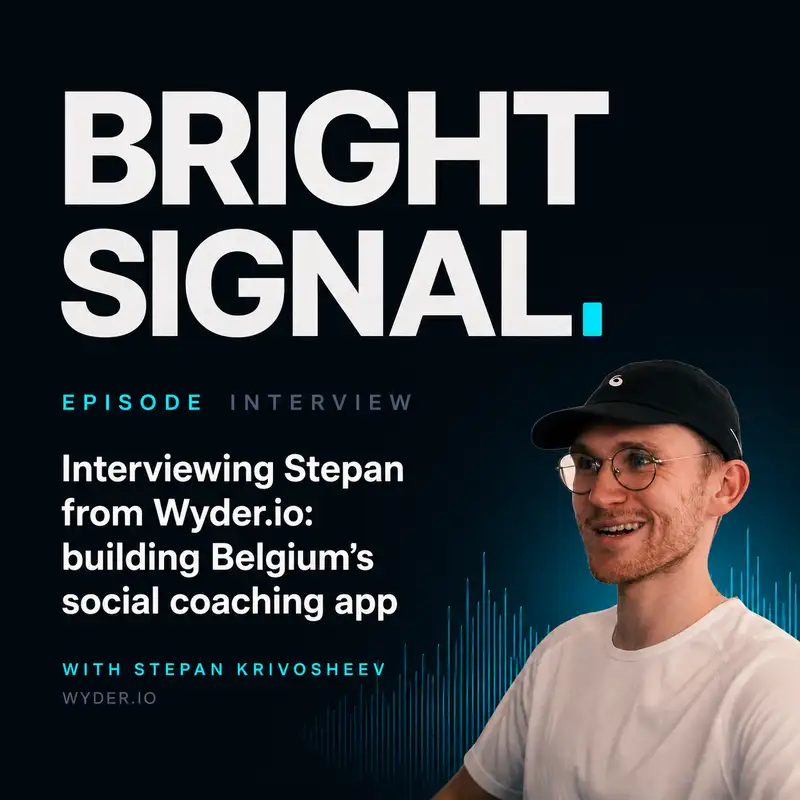
And we just had a very nice talk actually with Stepan from Wyder
Yes, Stéphane is the CEO and co-founder of Wyder, which is a very young Belgian solution
for endurance athletes, runners, cyclists and swimmers that is bringing coaching and
training to the next level by solving a very specific problem, training with others
without blowing up your personal plan.
So their pitch is easy, post a session, nearby athletes join in a tap and logistics is
handled.
So let's get to the interview.
Let's get to the interview.
Hi Stepan and then very happy to have you on board here.
uh Stepan is the one of the founders and CEO of Wyder.
We're gonna get all into what Wyder does but let's perhaps first let Stepan introduce
himself.
Indeed.
Thank you for having me on.
It's it's a pleasure to speak to you all.
and uh hello to all of the viewers of Bright Signal.
I'm Stepan as Bart introduced me.
originally French-Russian, uh been in Belgium for about three years, background in
international management and strategy, and uh also a past in consulting, value
realization, and uh now tackling uh first-time founder journey at uh at Wyder
Cool and impressive background.
Maybe to make the jump to wider, wider is very sports focused, right?
Can you give us a bit of an overview of what wider is, but also what is the origin story?
How did you get from that very much business focused background into a sports startup?
Indeed.
Yeah, no, it's it's an interesting story because I think uh it's quite tied together at my
time at uh during uh my time at Deloitte.
I got really into long distance travel on so it started with a half Iron Man and then
eventually moved on to a full one.
And uh during my time in training, of course, with the intense hours, I was training a lot
alone.
And uh although at the end of uh my block and when I finally completed my first Iron Man
in September of this year, it was great accomplishment.
I was really happy, but I was also very burnt out and burnt out aside from physically,
also mentally, because I spent the last 18 weeks basically in isolation, as finding
training partners and people to actually share that journey with was really complicated.
I looked and I couldn't find a way that would both allow me to hit my goals and yeah, find
somebody like-minded.
So I turned to a couple of friends, uh software engineers as well, and uh we went on this
journey together to build.
Wyder.
water as we like to call it is uh the world's biggest endurance sports club that you fit
in your pocket it's platform which allows uh you to uh train with other people by posting
your upcoming workouts but also it uh allows you very to very seamlessly uh create
training plans either with our own uh yeah agentic system in place or also now we're
starting to introduce uh yeah coaching uh functionality so that if you already have a
coach that you work with uh we can
enable them to train you through the wider application and save them uh the admin tasks by
uh yeah saving them time with a AI co pilot.
So that's a little bit about what we do and how we got there.
Cool, cool.
And can you explain a bit, you were saying you were doing it with two friends, how does
the founding team look like?
Yeah, so we're with three.
Uh we're Rafael who is a software engineer uh and did a master's in AI uh and data science
and Matthias who's a biomedical engineer.
Rafael does most of the programming and Mateas is uh transversal across the two business
and tech, and he does the project management as well uh for Wyder.
So yeah, of course, applying his uh background in the medical field.
do you all have like a sports interest, hobby, background?
Of course.
Yeah.
Yeah.
Indeed.
All three of us are athletes.
So as I mentioned before, uh I'm a long distance triathlete.
Rafael is a runner, quite avid.
he's training for a seventy-five K run uh now, trail run, and Mateas is quite avid
cyclist, now turn tri athlete, um by peer pressure via myself, yours truly.
So yeah.
And and and how did it go?
Like you you had the same patient and then and then just you just say to each other, Okay,
let's build together a solution around that or uh you had an ID and then and then just
call Mateus and and Rafael to to build it?
Um I actually yeah I had the pain at first so it started with the pain and I was I was
talking at first with Mateus and I was saying yeah it it it it's it's not not a great it's
a very lonely journey there has to be a better way I couldn't really join all of the
social clubs and social runs that were popping off at that time uh even though I really
wanted to they looked very fun but they just couldn't fit with my plan.
I spoke to Mateus, he had the similar problem.
Uh we started a bit ideating on what the
pot potential solution could be.
And then uh Mateus was at that time working at a different startup with uh Rafael and uh
we started talking the three of us uh first over over a drink uh more for more as a hobby
and then uh progressively over months it involved evolved to us finally leaving our our
jobs and going full time on it three months ago.
So that's yeah
i is is it scary to go from uh like a full time job in a in a consulting company to to
entrepreneurship?
It is, but at the same time at the moment things were moving and they're still are moving
that fast that it was scary to think about staying because uh we were thinking, yeah, we
either let this drop because it was becoming unsustainable to maintain both at the same
time, or we go for it full time.
So there is also was a certain amount of peace with making the decision because at that
point you knew, yeah, this is my goal, this is what I'm I'm working with, uh I don't need
to split my time anymore.
So
it's it's a double edged edged sword, uh but as a first time founder of course there's the
nerves.
And you said three months ago you you are dedicating this full time?
How how old is wider?
So the initial idea for Wyder started mid summer, last summer, but I was in the very
ideation phase.
And we really started working on it uh in October.
first it was uh one eighth time, then a quarter time, then half time, and eventually built
up to being uh parallel full-time job uh to what we were doing at the time.
And then February the thirteenth was my last day at at Deloitte and uh my colleagues they
they was
Based on notice period, there was one or two weeks later.
So starting from then.
Um so yeah, two and a half, three months ago.
cool maybe to focus a bit on like what wider is like you already explained a bit like I
also installed the application myself on my iPhone so
What I understand is like you can create workouts, you can potentially invite other people
to join your workout.
And next to that, since recently you also have these AI coaching features, which is new to
me, like you also allow human coaches to coach athletes.
There are...
quite a few of these type of applications, right?
Like what makes Wyder stand out?
Like what is your, what makes it stand out and also, maybe also what, who is your ideal
customer here?
Yeah, it's a it's a very good question.
Uh
What makes us stand out is that we're the first social coaching application.
So uh a lot of the time applications like maybe the Strava clubs or the run clubs that you
see online, they really focus on the social aspects.
So joining together, having a coffee after.
Uh and then on the other side of the spectrum, the training applications uh are very
focused on uh hyper scientific training and optimization for performance.
And we saw that's for somebody like ourselves, uh people that are working, so that's a bit
ties
Into your second question about the ICP.
Both are important, but both play a very major role because you cannot follow a plan if
your social life and professional life is falling under because we're not professional
athletes.
But at the same time, uh yeah, if you're training for something like an Ironman or a long
trail distance or yeah, a triathlon, even even a quarter triathlon requires very quite
heavy dedication.
you would need quite quite a heavy structure.
So it's balancing the two, the focus on performance and the f while finding like minded
people like yourself.
there.
So if we look at our CP it's young professionals, people aged from about uh twenty three
to thirty-five, forty years old, uh typically living in in bigger cities and working uh at
the at the corporate job.
That's that's what we've identified for our first wedge.
and by avid we also mean people that train five hours or more uh a week.
So that's a little bit who we're targeting at the moment.
It's already serious endurance at least, right?
Five hours or more.
Indeed.
Yes, indeed.
That's that's who we want to focus on at first.
Yes.
there a reason to why you're focusing on these type of athletes?
Yeah, indeed.
We see uh that those athletes are ones that have already tried um many solutions or are
quite uh let's say uh aware of what's present on the market and uh technologically
They have a certain technological proclivity.
They've used tools before.
They have wearables most often.
And also they their average spend on the hobby is quite high.
So triathlete a triathlete can spend upwards of three and a half thousand euros a year on
their hobby, which is why we believe the pay readiness in that sector in our first uh
stages is uh is the highest.
Maybe to walk me through as well.
Like if I let's imagine I I'm friends with Bart.
Imagine, hypothetically.
But imagine that w do we need to run the same race to to have this social component.
How does the app work if for someone that don't don't know?
Yeah, just to
We like to give the example of a marketplace.
and say you are training for a marathon.
And next week you on Saturday you need to run twenty kilometers.
But yeah, twenty kilometers is a long time.
you don't want to do it by yourself, but you have a certain pace that you need to run,
either hopefully assigned by the wider coach or maybe in in some somewhere else.
and you post that workout on Wyder, you say next Saturday.
At 9 a.m., I want to run 20 kilometers at a pace of 530 minutes per kilometer.
You can even upload the route so that people that join can easily export it to their
wearable and be able to navigate it.
And then BAT with uh C that workout if the visibility options that you selected allow it.
So the privacy is fully in the hands of the user.
You can choose that maybe everybody in the area can see the uh
workout.
Maybe only specifically people that you're in in the same group that you're a part of or
only your friends can see that workout or you can even make it invite only so only the
people that you actively invite would be able to see it.
Which removes obviously the friction because now as an athlete, uh before wider I would
spend half an hour in fifteen group chats sending messages.
I can't, yes, I can.
Which pace, which duration, which distance, where do we start?
And then you end up, yeah, spending uh time, mental space and effort just to end up
training alone because nobody responded in time.
So that's a little bit what what drove that first
Yeah, idea.
And of course we built on top of it with a coach.
That can first of all take all of those social workouts into account.
See that uh, for example, next week you have on Wednesday a workout planned with somebody
else.
Let me fit that into the training, maybe add a little bit to it, maybe make a rest day
after, because that's already quite a lot.
and then of course, all of the workouts that the coach creates for you, you can post to
wider just with one click and confirming a couple details.
And that's coach is the AI coach or the human coach or any.
For now, the only the AI coach is in place.
The human coach integration is something that we're working on and ideating.
We're having conversations right now with coaches to see what their needs are and to yeah
build the platform around them to really help them uh optimize their time.
So this is a feature that we're still currently building.
It's not yet in place in the application.
Maybe I also I w I have more questions on the the coach part, but uh but before I go
there, so you you mentioned the workflow for for someone that is initiating, let's say,
that is organizing the the run, the workout.
if like we are connected and you want to run, do I get a notification on my app?
How does how does that work?
Or do I have to log in the app to to see how how does that go for the the person that is
not organizing the the the run?
Yeah, so there's an explore page.
Um you can enter when you enter in the app, ranked by location, you can see everybody
around you that is yeah, either in your circle or just uh available to you.
You can scroll for all the workouts that are available and uh you can see the paces and
the distances there.
You can filter them as well with a filter that that we have in place.
and then once you enter it, you can see which route it is, export the route directly to
your wearable, you can uh
Yeah, copy the addresses, uh and uh yeah, you can join the workouts and check in to say
that you're you're joining.
So your app is also useful for uh people who usually train alone, which is for example my
case.
like to it gives also a nudge for uh sharing a session like a run or a swimming session
for with other people.
That's that's a very big part of what we're trying to do as well is is encourage people to
connect more because in this this age of uh yeah hyperdigitalization, a lot of uh
connection is online and we really want to try uh and enable people to uh connect in the
real world, uh share workout together, uh share a real connection because we truly believe
that's very important now for mental health as well.
So it's a social platform, like the challenge of a social platform is also that you need
to have a lot of people on there for it to be social.
Like, you share a bit on your approach there?
You need to start from scratch and like where, how do you tackle this?
How do you grow your user base?
Can you also show maybe a bit on what is your current user base?
Yes.
Maybe the easiest way to to to talk about this is about our journey so far.
So we're Leuven based and we we were founded directly in uh in the tracks of Aremberg.
and there we started our first yeah application and the application was initially blocked
off to everybody that's outside of Leuven.
meaning that if you wanted to join from from Antwerp, instead of showing you a blank
screen with no workouts in it, we just kindly asked you to
sign up on the wait list which allowed us to uh amass a critical mass in a specific city
before uh expanding outwards because but uh as you mentioned that's uh our the power of
our platform lies a lot in uh the user base
Then we would focus our efforts on go-to-market in a specific city by collaborating with
local businesses.
So local running stores, even student organizations, although we haven't been students for
a little while, communities, uh running communities in the city, doing joint events with
them and therefore attracting people to our platform.
last week we've hit a thousand four hundred euro 1400 users on our platform in Leuven
only.
And we uh so about two months and a half after, and we are expand we have expanded to
Antwerp last Friday with our launch event here.
And that is our second city that we're tackling.
Course scalability on long term is very important for us and going from city by city and
focusing all the founding teams effort on on uh one city is uh not scalable on the long
term, which is why we want to uh work with ambassadors and we're already going to start
testing this in Leuven with some uh influencers becoming wider ambassadors and yeah
helping us uh
continue activate the community there while our efforts can shift.
Maybe to zoom into the Leuven user base.
It's impressive to build such a user base in such a short period.
But like, is it critical enough mass?
Like this, like these thousand, 400 people, do you see that they create enough workouts
and these people participate enough?
Like, because I can imagine like a lot of people that join will be passive in a sense that
they're going to look at interesting workouts that pass by, but they're not going to...
host one themselves, right.
Indeed.
Yeah, that's that's uh that's a big part of what that's a big challenge that uh of course
we have to tackle.
because a lot of uh users as as we see they're very eager to join.
And whenever we host a workout, we we've had events with more than seventy people joining
at at once.
but hosting we have uh key users uh that we already we don't know them personally, but
yeah, we see them
ten, fifteen, twenty users that are posting quite often.
And the activation of the broader community that is that remains uh a challenge and we're
quite transparent at that and we're working on ways to activate the user base through
gamification challenges, things like that.
And and
the these these the special users quote unquote uh somehow differently?
Like the because I feel like they're very foundational, right, for the app to to to f
flourish.
Do you have any special I don't know, plans or anything?
Yeah, so um we've run a campaign called uh wider champion before.
we've had gamification where for uh each join of a workout you would get one point and for
each host of our workout you would gain three plus one point for every person that joins.
and the winner of that would get uh a t-shirt from wider with the date and the word
champion on the back in uh big letters.
and we've also introduced
We've recently gone through a UI uh UX redesign about uh let's say a week ago, uh week and
a half ago, uh, which is why the gamification still needs to catch up to that, uh, as it's
it's not yet in the new version.
But indeed that's that's a that's a point that we isolated uh a month, a month and a half
ago, and we really want to foster those users and make them feel very welcome on the
platform.
And do you work with current running clubs?
Because there are more and more running clubs in in the cities.
For example, in Brussels, I think there is a new running club popping up every every
month.
it creates a big user, like uh a hub of users.
You can also benefit from this kind of of running clubs or
Are the question is also are you replacing uh a running club or are you using also running
club to get these ambassadors in your in your app?
We are working together.
We would say we we would want to work together with running clubs.
We don't definitely want to replace them as uh we want to position ourselves as the
platform for social uh social events and uh yeah endurance events.
here in Antwerp, for example, we hosted it uh ourselves, our launch event together with uh
Hoka, the shoe brand, and Cofero, which is an endurance hub here.
in Leuven on the other hand we have done yeah collaborations with yeah Absolute Run which
is a store that also has quite a big community such a as a as a running club together.
we've of course worked as as mentioned before with Apollon for example.
We've worked with yeah Triathlon Londeren and uh Tedel Leuven which is yeah traveling
clubs uh in and uh around Leuven and as well with shoe retailers uh quite
quite a good uh with uh shoe manufacturers rather yeah so we've had cohabitation new
balance as well with brooks as mentioned with hoka so that's a little bit the avenues of
growth that that we've been pursuing so far.
Nice collaborations.
And over on the topic of collaboration, you were mentioning that you're going to try out
collaboration with influencers to also grow user base in certain geographic areas.
I was wondering, do you already have a view on how you're going to incentivize influencers
to do these things?
how do you tackle this?
Do you have a standard proposal?
Or is this always very custom made for a certain influencer?
What was very interesting to us when we started this journey is that we assumed that um
influencers would be very monetarily driven.
we we assumed that influencers uh would want money and it would be a simple exchange of
goods.
what we realize now is that we were wrong in that assumption and um most influencers or a
lot of them, especially uh micro influencers, for them the alignment with the brand is a
lot more important and the delivery of
an experience as well.
So f i in of course if if we start yeah tackling uh the larger scale influencers, people
with more than uh let's say uh more or around fifty thousand followers, yeah, typically
there's management and management fees to pay.
but before that it's
uh alignment and typically barter of goods and and hosting good events.
As we had quite for example at the our launch event here in Antwerp, we had quite a lot of
influencers join and as well do content about it as the event.
We had a DJ, we had drinks, we had uh a social run, we had uh music throughout the whole
time.
So of course it's also great content for them.
Do already have a vision on, because you're in Jens, you started a few months ago, so it's
still very early days, but do you already have a vision on how you're going to monetize?
Because I can see...
Like a lot of different things, right?
You have people joining workouts, you could monetize that.
Like you have a coaching aspect that you can monetize.
You can have a human coach that wants to coach other people that you could monetize.
You uh organize events for brands which you could monetize.
Like, do you already have an idea on where this will lead in the coming few years?
Yeah, um the main thing that we're working on right now, so we have two two levers that we
want to work on.
Firstly is our B2C lever, which is the training plans, the specifically the AI coaching
that we have in the application.
We launched it last Friday as well, adjacent to our launch uh in Antwerp.
Good timing for the interview.
Yes, indeed.
Think so too.
and that is uh priced at fourteen euros a month.
So quite below a coach, but yeah uh delivering uh yeah of course not the same uh not the
same experience, but somebody that you can uh talk to and ask for advice and that is more
aware of your context than other solutions that are out there now.
and then the second lever that we are working on is our B2B lever, which is of course
still in more the ideation phase than uh yeah, still live.
Uh and there like platfor we are tackling the approach and the main consumer being the
coach.
So the coach to pay for the service of having their athletes trained through wider.
So maybe just to recap for people that don't know the app or something, so you said there
is a there is a paid tier, which is the AI coach, but then everything else that we
discussed, the social part of posting and gathering people, this is all free.
Completely.
Yeah.
we see uh the the social layer of wider as a flywheel for the premium uh layer.
So we believe that it enhances the experience of a user, of course, to have to be able to
post their workouts and and train socially, which is why we want to keep it free and use
that as a funnel for for users.
So the the free to to paid conversion ratio will be really important for you in the coming
months.
Yeah, that's North Storm metric that that we look at, indeed.
think it makes sense that with that approach that you focus on athletes that have a high
willingness to pay, which typically is indeed triathletes, right?
The 30 plus triathletes that is used to paying a lot for nutrition, a lot for material, a
lot for coaching.
Because you do have this weird dynamic, if you don't look in this small niche of the 30
plus triathlete, there is this weird thing where people won't bat an eye on buying a bike
of 3000 euros, 4000 euros, but they will not pay 10 euros for a Strava subscription per
month, right?
There is this weird disjoint in willingness to pay here, but in certain groups like
triathletes, think there's definitely willingness to pay.
we've noticed that there's selves um and in ourselves as well.
Um because there's uh as you mentioned, people that pay thousands of euros for a bike, but
they still use my woosh instead of Zwift, and because that's the free solution uh for
cycling.
and there we we're trying to isolate because we've had this discussion ourselves within
the team of what separates something that the uh athlete is ready to pay for versus not.
And what we see is that uh performance gain is a very strong stimuli.
And uh yeah, if we can of course position ourselves as as a tool that can help you improve
your performance rather than just uh, for example, analyze data, it's it increases the
willingness to pay of a of an athlete.
And in terms of of of data, do you gather data from wearables, for example Garmin or like
Choros data, to to give the personalized training?
I I I mean the AI training, not like the the coach training, because with the coach
training there is a discussion also um so more on the AI coach.
Indeed, yes.
So uh we're very happy that uh since uh a couple of weeks ago we managed to integrate with
most leading wearable manufacturers.
So we have a connection with uh Garmin, Koros, uh Polar, Sunto as well and
course uh allows us to give uh quite a good amount of context to our uh agent to make very
informed decisions based on yeah on on the volume uh to assign to a specific athlete but
also on the type of training and as well on some metrics and of course on the completion
of a specific workout.
adaptations we're still working with it like active adaptations but already our our
platform is able to see if you have or haven't completed a specific workout
of course if you recorded it with a wearable and it allows you to analyze it and uh yeah a
adjust your load saying yeah this workout went this way, have a look and yeah.
What I find interesting is that you were already able to integrate with a lot of major
hardware vendors.
I've noticed, not necessarily in this niche, but that one of the side effects of the AI
native software development is that everybody is currently developing that project that
they had in mind 10 years ago.
which basically means that we see queues appearing at every integration application form.
Things like Google Auth takes way longer.
can imagine Garmin takes way longer.
There was a lot of stuff about Strava Auth taking way longer.
Did you notice this in this integration process, that it was harder than it would have
been two years ago?
It.
was one of the biggest challenges that we faced in the last couple of months.
wearable integration was taking ages and we still weren't getting approval uh and we
weren't even getting yeah an email back unfortunately at that time to the point where uh I
was calling uh at uh very uh early mornings American uh Garmin's Garmin's number for
fishing trawlers to somehow get the human on the phone and ask
Yeah what's what's going on and how how can we get there.
which is why we finally managed to find a way to integrate through a third party uh
service solution uh which works structuring data.
so we're collaborating, collaborating with them on that.
And we were very happy to uh yeah reach that because it was a big stress point for us.
I can imagine because you're extremely dependent on these hardware vendors, Especially
something like Garmin, which has like 80 % of the market.
Yeah, indeed.
Indeed.
Garmin, there was a workaround, of course, that we could use the Apple Health and it's not
Android Health, but yeah, the Android ecosystem health application.
but of course there, yeah, there was it was very prone to duplicates, uh and then aligning
that data between different var wearables active time is calculated d differently.
So there was uh yeah, uh a very large complication there.
but indeed the dependency is very heavy uh for
a lot of uh a lot of users now uh and uh yeah platforms as Strava and the the lawsuits
that were going on in in the last couple of months as well have proven how important it is
to all these platforms to also have credit for it.
So that's uh yeah also something that we all of course keep in mind.
Maybe um you mentioned how the AI coach also has access to these wearables, right?
So how if I'm if I'm considering to to have the purchase the the paid subscription and
using the coach, what else can I expect?
Does it part also mention nutrition?
What kinda advice or what kind of things can the the AI coach do?
Yeah.
Indeed.
right now, so the the coach first of all generates your plan.
So how how it works is that you uh enter in the flow and you tell it the the races that
you have coming up and you set the priority to the race.
So A for the most important races, B for the races uh that are still quite important for
you but less important than the A, and C is for more recreational races that you're doing
uh yeah on the side or as training.
You set yeah the priorities, you set the
Distances, your goal times, and after which you also connect your wearables.
We import the historical data from them and we see what your volume has been in the last
uh couple of weeks and months, and we uh create a uh overview of yeah where you are as an
athlete right now, and we combine that also with the uh quantitative and qualitative input
that a user gives.
So I can say I'm a beginner, I'm advanced, I'm yeah uh
uh quite yeah higher and active and also we combine that with the intensity uh and the
time that the user has to dedicate so if you are want your plan to be competitive if you
want it to be advanced if you want it to be beginner it's also about the intensity and we
shape all of that yeah into the agents and therefore generate the plan on top of that to
really make sure it can fit into the life of a of an athlete and combine with it.
And maybe how so you mentioned like there's some input fields and all these things.
How how does it how does it work?
Like are the input fields very structured?
Can I also write text?
Can I kind of say like yeah, I'm kinda intermediate, but I like to do this sometimes?
Or I got the question like, uh, are you a runner?
I said, Well, not really, but I do play football, so you know, I wanted to start.
So how how flexible is it and how how does it work in the in the back if you can discuss
it as well of course?
Yeah, of course.
Um so uh
We have different options.
So we have a very structured and preset fields where yeah you can click and select yeah,
I'm doing a uh long distance triathlon and then you indicate that.
You indicate which sports that uh you do.
So you can indicate I run, my typical running paces are between this and that.
and my yeah metrics for that specific sport are X, Y, and Z.
So for example, what's yeah, not to get into technicalities
of of training but my thresholds lactate thresholds so how uh how my energy systems are
used are this and this and if you don't know you can schedule a test as well and the coach
will will create a test to determine those
thresholds for you.
So you can you can go with the more structured routes, but as well we have uh yeah a way
right now if for example you want to do maintenance for now it's called maintenance you
can in your own language explain to it I would like to increase my cycling power well
threshold power let's say but again not to use too technical of terms I would like to
increase my cycling power over the next uh twelve weeks let's say and uh the coach can
take that
into account, look at what your base level is and from the unstructured input that that
you give create a program for your specific goal or for example if you're training for a
short trail race which is a bit rarer you can also uh explain it in a least less
structured way.
If I how how flexible is this as well?
Like if I say I'm I'm a football player and I wanna train for that, would it is I mean I
know it's probably not the intended use, right?
But uh how far can I push this?
You can definitely d indicate your your level there, but typically if you would say yeah,
uh I do run, but I don't know how how much I run because I'm a football player, I don't
typically do efforts on the distance.
What you can say is indicate uh yeah a specific
Indicate that you need a specific test to do it.
And then based on your fitness level, the agent will schedule a s a test in your calendar
for the upcoming couple of weeks that you would execute and then give the feedback back
into our application.
Say I hit this average pace and this average heart rate uh for that specific test.
and then it would take that into account to adjust your training zones and adjust your
plan in advance, but it uh fully unstructured.
we chose not to do that just because we need to that's also one of the challenges that we
have is balancing the safety of the training and uh yeah its validity with freedom.
So on the one hand, we can give the agent a lot of freedom to make decisions for the user,
but then of course we compromise the yeah, we we risk the training plans not being up to
our standards, which is why we chose to limit the journey to a certain extent so we can
have more control and be more confident of the outputs that it that it gives.
And to to to give like personalized training and safe training, uh you need a lot of data.
but maybe a challenge uh from what I observed in sports is that wearable sometimes don't
catch all the data.
Um I'm explaining, especially for multi-sports athletes, if I run I run with my with my wa
with my watch, it captures pretty much all the all the data but
If I'm cycling, I'm cycling with you know the the little Garmin box in front of your bike,
which is not capturing the data.
except if you have like this bracelet that you put on your chest or on your arm, which is
an issue, uh not related to wider but more on on the on the Garmin side.
But it's is this non monitoring of some of the aspects like for example the heart rate.
did you already
tackle this this issue or at least uh thought about that?
Yeah, so cycling is something that we think about a lot because it's one that poses quite
a bit of complications as uh many coaches that we talk to in the development of the
platform do believe that power, for example, is a very yeah,
Very important metric to use in cycling, but the power meter starts at 400 euros.
not everybody has one and not everybody, as you mentioned, can connect it, which is why we
also are right now working to include heart rate in the data, but we would need just like
a coach would, either power or in the future heart rate to be able to determine the the
zones specifically for cycling.
As otherwise uh it would be really hard to determine the performance.
Output a specific effort.
And we base a bit that methodology on what we see with coaches that we've talked to during
the development process as well.
Maybe on the topic of data, do you...
Well, something else like that I think is gonna become almost like you can't miss it as a
coaching application in the future anymore is stuff like sleep, stuff like HRV, like how
much you've recovered.
In the end, like it also comes down to the same hardware vendors like Garmin has their own
ecosystem and...
You also see that the same hardware vendors are at the same time also working on paid
plans on coaching while they have like full access, uh unlimited access to the data that
their devices provide.
Like, do you see this as a challenge?
And do you know about what you could do to build some safeguards against this challenge?
Indeed.
Right now, what we are focusing on is specifically on the performance and less on the
lifestyle.
Um, the reasoning for that is also just our capacity at the beginning.
we do of course plan to integrate biometric data such as you mentioned, HRV, sleep data,
and as well a native RPE recognition.
So when you do a workout and you can integrate integrate the RPE, the perceived effort of
a specific workout.
but we plan to integrate that into the coach.
Coaching dashboard as uh feedback for uh a coach specifically, and uh in the next couple
of months we will we will also start integrating that with uh the uh yeah agent on the B2C
side.
a lot of the time we see that raw data uh
HRV data, for example, is very it's more complicated to process because it it requires a
baseline.
my HRV and your HRV might be completely different, but we might both be in yeah, a healthy
for us zone.
so we see also quite a good amount of benefits uh in the processing of the data and
creating an infrastructure around visualization of said data and its utilization in making
decisions.
So uh
Of course there is a risk and unfortunately we are dependent on the wearables that uh that
we utilize.
but we we want to we see a software solution around that problem.
And maybe while we're on the topic of data, we're in the EU.
EU has a lot of regulation on data.
think what is very relevant here is GDPR, also the AI Act.
This is the data you're talking about is, I think it's classified as medical data.
It's at least very, it's at least high risk data.
How hard is it to launch something into the markets and being compliant?
Yeah.
That's uh that was a very, very big priority and that was something that we were uh quite
preoccupied with, especially at the beginning before commercializing the platform.
we are very lucky to uh have been selected for iUS Start, which was uh legal accelerator
here in Leuven.
And uh they they have helped us uh out a lot with uh being uh GDPR compliant uh and data
privacy policies and as well the protection of our intellectual property.
at the beginning, which is what we focused on quite a lot to make sure that uh yeah we
have all all of our terms and conditions and data policies are up to date and that we are
first of all also self hosting the models that we're using and and not the just using uh
yeah APIs and not transferring the data outside so
Indeed that's uh that was a big big big part of the first step when we decided to
introduce AI coaching uh into the platform.
That was a big big challenge that we we tackled.
Yeah, I think that
You mentioned your self-hosting parts, but basically because of this regulation, so it did
make an impact on architectural decisions.
Yeah, indeed.
So b by self hosting, yeah.
So we're uh where our models are through yeah AWS yeah, we're using AWS bedrock there and
in a secure environment.
So of course we we also seek advice from yeah others in in the space of AI to understand
how to set that up and we cross reference that that infrastructural advice with
start as well to make sure that we are fully legally compliant before we commercialize.
Yeah, yeah.
Our our architecture.
Yes, so you have like a Belgian footprint with a lot of partnership with local stores,
with uh local brands.
I guess that yeah this is the first step as you are a pretty pretty young a young company.
If you were on a cat table right now, like a round table, if you were to to raise funds,
what would be the allocation of
The funds that you would target?
I mean in terms of service.
do you want to target first marketing, a new geography, a new a new like market product, I
don't know, like tech development?
What would be what would be the use of these funds?
Yeah.
mainly.
Are a big part of our so as a consumer product as well at at its core.
Of course, we're developing a B2B side right now, but it as mentioned before, it is not
yet uh in place.
marketing will be a big big part of it.
Uh our community is what drives us, and creating events uh and content that uh truly
drives the community, of course.
so of course that it costs a good amount of money.
and as well, uh we see a strong need for rap.
expansion.
So of course uh once our model is validated and we we're able to sustainably grow in
cities uh we will need to very quickly expand and as well grow uh our our network of
ambassadors um
uh the the geographies that we expand to so the we dedicate that as well a good chunk and
thirdly is development efforts because right now uh code is written by our CTO uh Rafael
mostly uh let's say 80 percent 80 to 90 percent and although we are applying uh all the
best practices of course with yeah agentic
say development.
we also prioritization is something that we are having to do on a daily.
Do we fix that bug that has been reported to us or do we push for the new feature that we
promised to release?
And of course we create timelines and of sure as as as you know as well, create timelines
and
Then a bug happens and we have to spend two days fixing it.
And we we need additional developer gun power, not just for yeah, just increasing the
capacity, but rather to be able to separate tasks and uh clearly dedicate uh efforts on on
on separate things.
You you didn't fundraise yet, huh, if I'm not mistaken.
You are not preceded.
No, no, we are fully bootstrapped at uh until this Monday or maybe even until uh today
formally as it arrived.
We did receive non-dilutive grant funding from the from VLIO.
we're no thank you very much.
We were notified uh last week of it and but this week we are we can say fully that we are.
And you a
on the topic of funding, like you're completely bootstrapped, have a grant of the
government.
It will probably not last you three years, right?
So at some point you probably need to raise money.
What's your plan there?
Yeah, so uh at uh of course again we're all first time founders, all all three of us in
the team, so we're learning as as we go and we're very transparent about that.
Uh and at the beginning we were very uh let's say
maybe not avid, but very yeah, ready to fundraise from the very first trades, which first
of all pose itself as quite complicated as at that moment traction numbers were not uh not
there yet.
but uh secondly it after
of months we came to the realization that waiting until uh we have the traction in place
if we can afford to wait and if we can take that risk on ourselves could be a better s
strategic solution for the long term.
So right now we are focusing on uh sustainable traction numbers in the next couple of
months before raising a couple of weeks slash months before raising a pre seed uh round
there and
Of course, there's still a lot of yeah decisions that we have to make because for us a
strategic partner, one that can help us as well with uh our our development of our go to
market is very important as we are aware of our limitations and uh we we know that of
course an advice uh sounding board is very important for us, especially at this stage.
And if you were to choose one specific not not name a fund but what would be the the the
like because we we we talk a lot about smart money uh etc like the the involvement of also
of the external shareholder in a company what w would be your ideal the ideal fund that
would be in in your capital, like in terms of the the skills that they have for you?
Yeah.
I think in uh especially in our pre-seed round, we we would really want to focus on uh
angels, and we want to focus on individuals who have had past experience, of course, uh
scaling and growing uh technology startups, uh, specifically in the EU, as we we are based
here and we want to grow here.
we also, in an ideal world, would want somebody that understands endurance sports and the
technicalities uh of it, as we see that as an industry that is quite.
rapidly growing right now and yeah it's requires as well some some understanding and some
network as well to grow.
And thirdly is yeah that that network because w to expand rapidly and expand abroad a
strong network among the insurance space is is very important.
So somebody that is involved of course in the endurance business uh would uh would be yeah
a very very big plus for us.
.
we are not used to see sports tech in the in the funds.
I can I I think I can't even name one fund uh like in this specific topic.
I think there are a few worldwide.
think the most well-known is probably Next Ventures by Lance Armstrong.
There are only a few dedicated sports tech VCs.
But maybe also something that is with Bright Signal we're focusing on European textile
ellipse.
But what I also do notice, unfortunately, that there are very few...
big VCs in Europe that truly want to do B2C.
Yeah, yeah.
if you encountered this challenge?
One hundred percent.
Yeah, that's that's something that that of course right now as fundraising is of course is
so quite important to us, but not the main thing.
We're focusing on our product first and our go to market.
but before we noticed it a lot.
we had uh a lot of interest and but a lot of the times fund would tell us, uh yeah, we
only focus on B to B.
Our portfolio is fully B to B.
We only work with B to B as we believe the risks are lower.
And of course in the US we've heard uh yeah, that's the perspective on that is a bit
different as it's uh of course high risk but also very high reward.
Yeah, exactly.
I think the simplification in the US is that if the restriction is a very big market,
right, and if you have a Belgian VC and that takes risk of doing a B2C, they're not
accustomed to if it works, it's just Belgium and it's not enough, right?
Like, the next step is again a risk, right?
And I don't honestly don't think it's impossible to get funding for...
B2C in Europe, but probably a bit what you're saying, like you need to show that you have
enough traction to really make people believe in it and to basically de-risk a bit for
these funds,
Yeah, that's that's exactly where our reasoning for delaying a little bit the the the
process of fundraising lays is with the fact that we wanna create traction and take the
risks ourselves and to create confidence in the investors that uh join us.
sense.
Yeah, maybe related to that, if we ask you what the next twelve month look look for you,
what would be your priority right now?
Yeah.
so it
For us it goes from uh yeah local to already global to semi-global.
so firstly we want to create uh sustainable traction here in Antwerp as well.
So we've uh we've had traction in Leuven and we've want to apply the same playbook to
Antwerp and validate it on a bigger city and a bigger playground.
also yeah as as I mentioned previously, we've launched our uh
yeah.
B2C premium offering, so of course uh our first revenue numbers as well are are gonna be
quite important for us and the conversion uh numbers there, really focusing on on CAC, uh
LTV, the ratios between that and how we can optimize that, looking at churn and looking at
the metrics and really isolating the first mistakes that we have, which we will, and
approaching that very numerically.
and following that.
That is uh of course our expansion across Belgium and into strategic cities.
So we've isolated about thirty cities around the world uh and
orders of priorities either from a perspective of just large population centers such as
those could be uh Paris, Madrid, London, New York, uh but also cities such as Ancy,
Chamonix, Boulder in Colorado, cities that by population, they're not very big but they
have a very avid
endurance athlete community in them and uh that would create a lot of ambassadors for us
if we do expand to them.
so that would be the the second step is uh going down that priority list and beginning uh
expansion.
and of course once our revenue numbers do hit the values that we believe are sustainable
enough to to open around we will do so and open a first pre-seed round.
And you you have a business that depends on on the number of users.
Let's imagine that you have like ten million of users.
Is there like a feature in in in Wyder that's you would love to implement but you are not
implementing right now but because of the bandwidth?
But let's imagine that you have a lot of users.
Is there any specific feature that you would implement?
there's there's so many that that we think about.
First of all, we need to strengthen our gamification.
We we believe there's there's real value in that, but of course it's not directly tied to
performance uh for users, so we're not focusing as much uh on that.
So that that is a very big part that that we have in mind.
additionally to that we of course want to yeah work a lot more on
our visual side, yeah, things such as animations, UI design, and branding within the
application.
We do everything that we can on our side, but we also uh know that if we take a a much
wider approach, this this can be refined quite a lot, pun intended.
and then as well additionally to that we we see a lot of
benefits and a lot of data visualizations.
And there the complex part is about providing the user with enough data without uh
overcomplicating it because that's what we hear a lot from uh users that have tried other
platforms is that they open it and it feels like a Airbus 360 yeah cockpits.
There's buttons and graphs all over the place and you don't really understand what they
mean and it's a bit overwhelming and we really want to avoid that so we want to be very
conscious with what we add.
let's imagine that I I do a race in two months.
I do a a 20km training, I just post it on on Wyder.
Bart and Murillo see it, they join me.
But is the inverse also doable?
I'm explaining.
we are training together, Murillo, Bart and myself.
And we don't have the same level but we want to do a race together.
Is like wider can Wyder find a race based on our performance that would fit us like in
terms of level of of of training.
We haven't thought about that feature of selecting a specific race yet, but what we did
think of is do and trio plans.
So for example, if the three of you say, Okay, we want to do a marathon in November uh
together, uh you can sign up for the same goal and tie your profiles together.
through through the application and then uh yeah maybe for for one of you the session
would be a threshold session or for another person that same session would be in the
calendar as a recovery session.
So it's align the workouts together, allowing everybody to hit their specific goal.
Maybe one of you is going for a sub four, the other one is going for a sub three and the
other one is going for a sub two thirty, for example, uh marathon time.
And then everybody can get as much
Training and optimize around their goal while still maximizing training together.
It for example, two weeks ago I ran with a middle distance runner, not to drop names, and
that that person he he is going uh on to the Belgian championships and everything.
And I set my ten kilometer PR on that run.
his heart rate was one twenty-five, so that the
a recovery run, a very, very easy uh session for him.
He was fully talking, he was not even breathing heavy.
I do consider myself a bit of an avid athlete, so that was very humbling.
And this is exactly what we want to encourage.
People of different levels still finding a way to connect and train together while hitting
their own goals.
Guys, among us I'm not doing uh the under a two thirty, just saying I'm not the one doing
that.
Me neither.
Me neither.
I'm I'm not yeah, I'm definitely not there.
Maybe to wrap up Stepan, a very interesting project that you're working on.
I can imagine that there are a lot of athletes, especially the ones that train them many
hours, that do a lot of workouts on their own and for...
whatever reason, whether it be practical or others, like it's hard for them to schedule
something with friends or baby teachers don't know enough people that can run the same
pace as them.
Like what is the best way for them to check out wider?
Um I would definitely say our uh social media.
We're very active on social media.
You can find us uh on Instagram specifically, but also uh on on on TikTok as well.
we try to really approach this as uh showing our journey and and building in public,
explaining our experience, our mistakes, uh and as well of course not taking ourselves too
seriously while while building a community together.
So it's
In the terms, LinkedIn is a bit more formal and uh Instagram is really the journey of
three guys trying to build something great for the endurance community worldwide.
Thanks a lot for joining us.
We'll definitely make sure to check your progress in the coming months and years.
I have the app installed and I live very close to Leuven where you already have a lot of
users.
So I'll definitely join one of the next workouts.
Amazing.
Thank you very much for having me.
Thank you.